


Key Takeaways
- A diabetic or idiopathic neuropathy diagnosis does not rule out other, treatable contributors to your symptoms.
- We evaluate your full history and your back, pelvis, hips, and legs — not only your feet.
- A nerve-conduction test gives useful information. It does not replace a hands-on evaluation.
- Treatment may include myofascial release, guided movement and strengthening, balance and gait training, and laser therapy, based on what your evaluation shows.
- You do not have to stop any medication, including gabapentin, to be evaluated.
Peripheral neuropathy is nerve damage or irritation outside the brain and spinal cord, often causing burning, tingling, numbness, or weakness in the feet and hands.
Diabetes and chemotherapy are common, well-established causes (StatPearls). Sometimes no clear cause is found, which is called idiopathic neuropathy.
At Synergy Therapeutic Group in Carbondale, IL, we evaluate the whole pathway those nerves travel — spine, pelvis, hips, and legs — not only the feet, because mechanical contributors along that path can sometimes be addressed with physical therapy.
Your feet burn. They feel numb. Looking only at the diagnosis on your referral may not be enough.
Maybe it started with tingling in your toes. Now your feet burn at night, your socks feel uncomfortable, and you watch the ground when you walk because you do not quite trust what you are feeling. You have been told you have neuropathy. You may already take gabapentin or another medication, and you still have questions: why did this happen, are your nerves permanently damaged, and is medication all you can do?
At Synergy Therapeutic Group, we begin with a thorough physical therapy evaluation. We look at your symptoms, their history, and the possible contributors — not just the diagnosis written on your referral.
Why a neuropathy diagnosis is not the end of the exam
A diabetic or idiopathic neuropathy diagnosis explains what you were told, not everything that could be contributing. Diabetes can cause nerve damage. Chemotherapy and other medical conditions can also affect peripheral nerves. I am questioning something else — something I have repeatedly encountered in practice.
People come to me already diagnosed with diabetic neuropathy or idiopathic neuropathy. Some have seen a neurologist. Some have had nerve-conduction testing. They have been prescribed medication and return for follow-up visits, believing the explanation is settled. “My nerves are damaged. What are you going to do?”
Here is my experience: in this particular group of patients referred to me, I have yet to examine someone whose symptoms I felt were fully explained by the diabetic or idiopathic label alone. I have found other problems that deserved attention — often involving their back history, previous surgery, movement restrictions, or possible nerve irritation and compression.
Two things are true at once. This is an observation from my practice, not a claim about every person with diabetic neuropathy. And it is not about an obvious foot drop immediately following back surgery — that is its own clear case. It is about people whose symptoms were given a broader label that may have left part of their history unexamined. The diagnosis tells me what you have been told. I still need to examine you.
“Idiopathic” means the cause has not been identified — it does not mean there is no cause, and it does not automatically mean nothing can be treated. When someone comes to me with that diagnosis, I still want to know what has been examined, and I assess their movement, sensation, strength, balance, and mechanical findings. “I do not know why” and “there is nothing useful to do” are different statements.
A pattern I have seen: when the numbness has a history before the diagnosis
One case from my practice illustrates this well. A man who had worked for years in physically demanding labor came to me with longstanding back pain and two prior back surgeries. His back felt better afterward, but his buttock remained tight and numb, and he also had episodes of numbness in his feet. Later, he was diagnosed with diabetes, and his foot symptoms were then called diabetic neuropathy — but the numbness had a history before that diagnosis.
When he came to me, he saw the two problems as separate: his back had been operated on, and his feet were now “a diabetic problem.” If the diabetes was not going away, how could treatment possibly help his feet? That understanding mattered — it affected what he thought was possible. His history and my examination gave me reasons to investigate mechanical contributors along the nerve’s pathway. The diabetes diagnosis did not remove the need to do that.
The sequence alone cannot prove the cause, but it gives us questions we should not skip: did the numbness begin before the diabetes diagnosis, what symptoms remained after surgery, and had anyone assessed whether movement or position changed those symptoms? Having diabetes does not make every symptom diabetic. You can have diabetes and a back problem. You can have diabetes and a compressed peripheral nerve. More than one thing can be happening — and the same care we give the diabetes history has to apply to the history of your back, your surgeries, and your symptoms.
Why we look beyond your feet
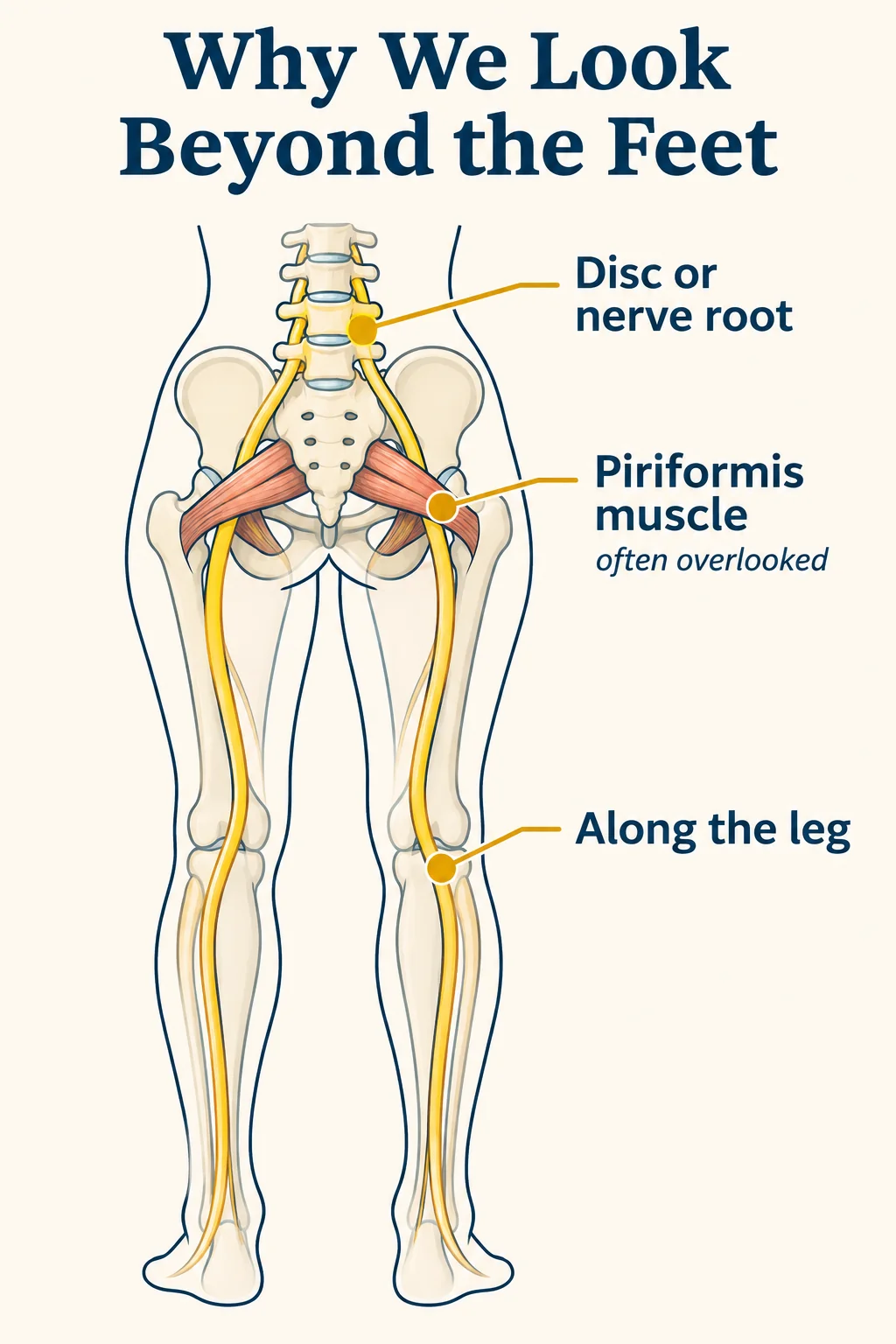
Your feet are where you feel the burning or numbness. That does not establish where every part of the problem begins. The nerves serving your legs and feet connect to the spine and travel through the pelvis and legs, so symptoms farther down can sometimes relate to a problem elsewhere along that pathway — and that pathway has more than one place a nerve can be irritated or compressed. That is why we ask about your back even if it is not hurting much now, why previous surgery matters, and why we may examine your pelvis, hips, and legs when you came in asking about your feet.
One site I check specifically is the piriformis — a small muscle deep in the buttock that can irritate the sciatic nerve even after a back surgery that was otherwise the right call. The piriformis, a small muscle deep in the buttock that the sciatic nerve runs beneath or, in some people, directly through. Even after a back surgery that was the right call, the piriformis can still be tight enough to irritate that nerve, and because the surgery already “explained” the leg or foot symptoms, nobody goes back to examine the pelvis. This can show up on one side or both, and it is easy to miss precisely because the back history looks like it should have been the whole answer. We are not assuming your back caused everything, and we are not assuming the piriformis did either — we are checking whether either one, or both, contributes. If we examine only the feet, or only the part of the story already on your chart, we may miss something relevant to the feet.
What a nerve-conduction test does and does not tell us
A nerve-conduction study measures how signals travel through the nerves being tested, and it can provide important information about nerve function. It does not replace your history and physical examination. An abnormal result needs to be interpreted in the context of the pattern, location, and possible causes, and a normal result does not rule out every nerve condition. So I want to know what the findings actually showed — not simply that you “had a nerve test” — and I still need to ask what is contributing to the problem and what we can reasonably address. Testing and examination work together.
Why I take nerve disease seriously
Earlier in my career in India, I participated in treating patients with leprosy. I felt thickened peripheral nerves and saw the gradual loss of sensation and function that disease could cause. That experience does not mean every neuropathy should look like leprosy, but it does explain why I do not use the words “nerve damage” casually. I take those words seriously because patients take them seriously. Once someone believes their nerves are permanently damaged, they may stop looking for help, assume every change in sensation is permanent, or believe exercise and physical therapy cannot possibly make a difference. We need to explain what we know, what remains uncertain, and what may still be treatable.
How I evaluate neuropathy
I start by listening to the sequence — not just how bad the pain is, but when it started, how it changed, and what happened before it. I ask about previous treatment, surgeries, medical conditions, medications, and available test results, and what helps and what aggravates your symptoms. Then I examine the areas relevant to your presentation: the pattern and location of your sensation changes; your strength and movement, including how well your back, hips, pelvis, and legs move; tissue restrictions and possible mechanical contributors, checking whether particular movements or positions change your symptoms; and your balance and walking, including whether you watch every step, reach for furniture, or avoid stairs or uneven ground. Those difficulties deserve treatment whether or not your symptoms are painful. Some findings need additional medical or neurological investigation — when that is the case, we explain it and coordinate with your healthcare provider.
How we treat what we find
We do not give everyone with a neuropathy diagnosis the same treatment. Your plan depends on your examination, your medical condition, and the activities you need to improve.
- Hands-on treatment and myofascial release — when relevant tissue and movement restrictions are present, treatment may involve your back, pelvis, hips, or legs, not only the painful or numb area. We follow changes over time; feeling better is useful information, but it does not by itself prove nerve damage has reversed.
- Guided movement and strengthening — you may need to regain strength, improve control, or learn to move without repeatedly aggravating symptoms, adjusted to your ability and response.
- Balance and walking training — reduced sensation can make everyday walking uncertain, so we work on foot placement, strength, balance reactions, and practical activities like getting up from a chair or managing steps, and assess whether an assistive device would help you move more safely.
- Laser therapy — may be part of your plan to help manage discomfort when appropriate, but treatment cannot begin and end with a machine pointed at your feet. We do not promise that laser will regenerate damaged nerves; we use it as an additional tool and assess whether it is helping you.
If you have lasting nerve damage
We do not dismiss established nerve disease, and we do not assume lasting nerve damage makes rehabilitation pointless. You may still improve strength, balance, mobility, or confidence with walking. You may benefit from strategies that help you manage reduced sensation, and we may find additional restrictions that are making daily activity harder. Treatment goals can be meaningful even when complete recovery of sensation is not possible — we need to distinguish what cannot be changed from what has not yet been addressed.
What to expect, step by step
We listen to your full sequence, including surgeries, prior test results, and what you have already been told.
We examine sensation, strength, movement, and mechanical contributors in your back, pelvis, hips, and legs — not only your feet.
Hands-on work, guided movement, balance training, and laser therapy where appropriate, based on what your evaluation shows.
We compare symptoms, movement, and function from visit to visit, and reassess rather than repeat what is not working.
When you should come see us
- You have burning, tingling, numbness, or unusual sensitivity in your feet.
- You have a diabetic or idiopathic neuropathy diagnosis but still have unanswered questions.
- You have a history of back problems, surgery, or persistent buttock symptoms.
- Your symptoms change with sitting, standing, walking, or position.
- You feel unsteady or have started avoiding activities.
- You want to understand whether physical therapy can address something contributing to your symptoms.
We also evaluate people with established neuropathy who need help with strength, walking, and balance. You do not have to know which explanation fits before contacting us, and you do not have to stop gabapentin or another prescribed medication to be evaluated — just let us know what you are taking and discuss any medication changes with your prescriber, not on your own.
Ready to talk?
Call us at (618) 243-7822 or request an appointment online to schedule a neuropathy evaluation. You may have diabetes, you may have nerve damage, and you may also have something treatable that deserves attention — we listen to the history, examine beyond the symptom, and look for what we can reasonably help.
Request Appointment Call (618) 243-7822
Conditions connected to neuropathy
- Back Pain & Sciatica — the back history we check in every neuropathy evaluation
- Myofascial release — part of how we address mechanical contributors
- Laser therapy — an additional tool for managing discomfort
- Manual therapy — hands-on assessment and treatment of movement restrictions
Recommended Reading
Deepen your understanding with these related articles from our health blog:
Frequently asked questions
I already take gabapentin. Can I still come in?
Yes. You do not have to stop your medication to be evaluated. Gabapentin or another prescribed medication may help manage discomfort, but it does not answer every question about movement, weakness, balance, or possible mechanical contributors. Tell us whether it helps and whether you have side effects like sleepiness or dizziness, and discuss any medication changes with your prescriber, not on your own. Physical therapy and medical management can be part of the same plan.
What does “idiopathic neuropathy” mean?
It means the cause of the neuropathy has not been identified. It does not mean there is no cause, and it does not automatically mean nothing can be treated. We still assess your movement, sensation, strength, balance, and mechanical findings, because there may be something physical therapy can address even when the medical cause remains uncertain.
Will you tell me my nerves are permanently damaged?
Only if the evaluation and any testing actually support that. We do not use those words casually, because once someone believes their nerves are permanently damaged, they may stop looking for help that could still make a difference.
Can physical therapy fix nerve damage?
We cannot promise to reverse established nerve damage, and we will not claim that. What we can do is evaluate for treatable mechanical contributors along the nerve’s pathway, and work on strength, balance, and walking even when some nerve damage is permanent.
Do I need a referral or a confirmed diagnosis before I can be evaluated?
No. You do not have to know which explanation fits before contacting us. We also evaluate people with an established neuropathy diagnosis who need help with strength, walking, and balance.
What if my evaluation does not find anything to treat?
Then we will tell you that honestly. We distinguish what cannot be changed from what has not yet been addressed, and we will not invent a treatable finding that is not there.
This page is for general education, not medical advice. Everyone’s body and history are different. Sudden or rapidly worsening weakness (including weakness in both legs), new loss of bladder or bowel control, new sexual dysfunction, or numbness around the groin requires urgent medical evaluation. Synergy Therapeutic Group does not replace care from your physician. Synergy Therapeutic Group · 1110 N Cedar Court, Carbondale, IL 62901 · (618) 243-7822.