

Key Takeaways
- Perceptual difficulties are trouble organizing and making sense of what a child sees, hears, or feels.
- A child can have perfect eyesight and still struggle with visual perception. They are not the same thing.
- It shows up as reversing letters, losing place while reading, trouble with puzzles, and uneven spacing on the page.
- Because it looks like carelessness, it is often missed for years.
Reviewed by Chandana Dash, OTR/L — Co-founder, Synergy Therapeutic Group
Perceptual difficulties in children involve trouble organizing and interpreting sensory information from the eyes, ears, or body — affecting how children make sense of what they see, hear, and feel.
It affects children with visual processing differences, auditory processing challenges, body awareness issues, and many children with broader developmental, sensory, or learning differences. The most common signs are difficulty copying from a board, losing place while reading, bumping into things, trouble following multi-step directions, and frustration with puzzles or visual tasks.
Unlike conventional approaches that focus only on the school task, Synergy Therapeutic Group treats perceptual difficulties by retraining the underlying sensory systems — visual processing, body awareness, motor planning — so the foundational skills support all the tasks that depend on them.
Your child’s eyes may be fine. The brain that processes what the eyes see may need support.
Vision is more than eyesight. After the eye captures an image, the brain has to interpret it — what is the object, where is it in space, how does it compare to other objects, what does that shape mean, how does it relate to what the body is doing. When that processing pathway has a weak link, a child may have 20/20 vision and still struggle in ways that look like learning problems, motor problems, or behavior problems.
What visual perception actually does
Visual perception is the brain’s ability to make sense of what the eyes deliver. It is built from several sub-skills working together:
- Visual discrimination — seeing the difference between similar shapes, like b and d, or was and saw
- Figure-ground perception — picking one object out of a busy background (finding the friend’s face in a crowded classroom)
- Spatial relations — understanding where objects are relative to each other and to the body
- Form constancy — recognizing that a letter is the same letter even when its size or font changes
- Visual memory — holding a visual image in mind to compare or reproduce it
- Visual-motor integration — coordinating what the eyes see with what the hands and body do
How perceptual difficulties show up
Children with visual perception challenges often have one or more of these patterns. They reverse letters past the age when most children stop. They lose their place when reading. They can’t find an item in a drawer or backpack even when it is right in front of them. They run into furniture, miscalculate stairs, or struggle to catch a ball. They have trouble copying from the board. They get overwhelmed in busy visual environments. They take longer than peers to complete tasks that require interpreting visual information.
Parents often hear “they will grow out of the letter reversals” or “their eyes are fine, the eye doctor checked.” That can be true and still miss what is happening. The eyes are working. The processing of what the eyes deliver is what needs support.
Why this matters for learning
Almost everything a child does at school depends on visual perception. Reading depends on discriminating letter shapes and tracking across lines. Math depends on understanding spatial relationships and place value. Writing depends on visual-motor integration. Sports and PE depend on judging distance and trajectory. A child with a perceptual gap may look distractible, slow, or behind — when the real issue is that the visual information their brain is receiving is harder to use than it should be.
How we approach visual perception
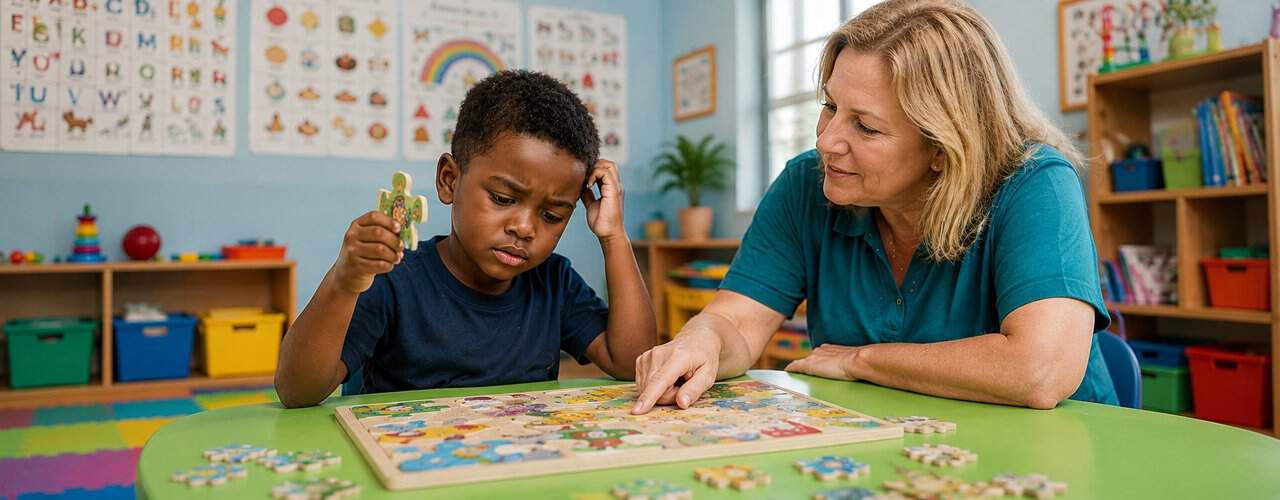
An evaluation at Synergy looks at each of the perceptual sub-skills above. We use both standardized assessment tools and observed performance — how the child manages real visual tasks like puzzles, mazes, copying, finding hidden objects, and catching or aiming.
Therapy is play-based and skill-specific. We use games that train discrimination, figure-ground, spatial reasoning, and visual memory. We integrate visual perception work with motor activities so the eyes and the body learn to coordinate. We also coach families on the everyday activities — puzzles, board games, ball play, building, drawing — that strengthen these systems naturally.
When appropriate, we coordinate with a developmental optometrist if the child’s case suggests an eye-tracking or vision-therapy component beyond what OT addresses. The two specialties are complementary, not redundant.
Closely related areas
- Handwriting problems — visual-motor integration is central
- Learning disabilities — reading and math depend on visual perception
- Sensory processing — vision is one of the senses we integrate
- Motor planning — depends on visual feedback
Recommended Reading
Deepen your understanding with these related articles from our health blog:
Frequently asked questions
Why does my child reverse letters past kindergarten?
Letter reversals are normal through kindergarten and into early first grade. Persistent reversals beyond that — particularly b/d, p/q, or whole-word reversals like was/saw — can reflect visual discrimination, directionality, or visual-motor integration challenges worth evaluating. Reversals alone are not dyslexia, but they can be part of a broader pattern.
Is dyslexia a visual problem?
Primarily no — dyslexia is mainly a language-processing condition affecting how the brain decodes written symbols. However, many children with dyslexia also have visual-perceptual challenges that compound the reading difficulty. Addressing both gives better outcomes than addressing either alone.
What is the difference between vision therapy and occupational therapy for perception?
Vision therapy, provided by developmental optometrists, addresses how the eyes themselves work — tracking, focusing, binocular coordination. OT addresses how the brain interprets visual input and integrates vision with motor function. Some children benefit from one; some benefit from both. We refer when appropriate.
Can perceptual difficulties be outgrown?
Some patterns mature with general childhood development, but others persist without targeted support. Visual-perceptual systems are most plastic in early childhood — early evaluation and intervention produce meaningfully better outcomes than waiting.
How is visual perception tested in children?
Through a combination of standardized assessments — tasks measuring visual discrimination, figure-ground perception, spatial relationships, visual memory, and visual-motor integration — plus observed performance on real-world visual tasks like puzzles, drawing, copying, and play. The evaluation gives a specific picture of where the perceptual system is strong and where it needs support.
This page was reviewed by Chandana Dash, OTR/L, who has practiced pediatric occupational therapy for more than 32 years. She specializes in family-centered care for children with sensory, developmental, motor, and neurodevelopmental challenges. She is the co-founder of Synergy Therapeutic Group in Carbondale, Illinois.
What is visual perception in children?
Visual perception is how the brain processes what the eyes see — recognizing letters, spatial relationships, depth, and detail. It is different from visual acuity (sharpness). A child can have 20/20 vision but still struggle to copy from the board, read fluently, or judge distance when catching a ball.
What are signs my child has visual perceptual difficulties?
Reversed letters past age 7, trouble copying from the board, difficulty with puzzles, getting lost in familiar places, poor spatial awareness, missing details in pictures, struggling to find items in a cluttered room, and reading below grade level despite normal vision.
Can occupational therapy improve visual perception?
Yes — OT addresses the brain processing of visual information through targeted activities: visual tracking, visual memory games, visual-motor integration tasks, and graded perceptual challenges. We work alongside developmental optometrists when vision therapy is also needed.
This page is for general education, not medical advice. Everyone’s body and history are different — for guidance on your specific situation, talk with a licensed physical or occupational therapist. Synergy Therapeutic Group · 1110 N Cedar Court, Carbondale, IL 62901 · (618) 243-7822.