

Key Takeaways
- Dyspraxia, also called Developmental Coordination Disorder, affects about 5-6% of school-age children.
- It is difficulty planning and sequencing movement. It is not clumsiness, and it is not a lack of trying.
- New or unfamiliar tasks are hardest. Once a movement is truly learned, it often looks fine.
- It commonly overlaps with ADHD, sensory differences, and learning differences.
Reviewed by Chandana Dash, OTR/L — Co-founder, Synergy Therapeutic Group
Dyspraxia, also called Developmental Coordination Disorder (DCD), is a motor learning difference that affects a child’s ability to plan and execute coordinated physical actions.
It affects approximately 5-6% of school-age children, often co-occurring with ADHD, sensory processing differences, and learning disabilities. The most common signs are clumsiness, difficulty learning new motor skills, awkward pencil and utensil use, trouble with sports and physical games, and tasks that take significantly longer than they should for the child’s age.
Unlike conventional approaches that label the child “clumsy” or push more practice, Synergy Therapeutic Group treats dyspraxia by building the underlying sensory-motor foundation, breaking new skills into achievable steps, and developing the body awareness that coordinated movement depends on.
Dyspraxia is not a character trait. It is a coordination pattern. With the right kind of work, the body learns.
Dyspraxia — also known as Developmental Coordination Disorder, or DCD — is a recognized neurodevelopmental condition affecting motor coordination. Children with dyspraxia have meaningful and persistent difficulty learning, planning, and executing physical movements that other children pick up with relative ease. It is not the same as muscle weakness or a neurological injury. The muscles and nerves work; the brain’s internal system for organizing movement is the part that needs support.
What dyspraxia looks like
Children with dyspraxia often look uncoordinated. They are typically late to milestones like jumping, hopping, riding a bike, tying shoes, or using a knife and fork. They may seem clumsy — running into things, dropping objects, knocking over cups. They struggle with both gross motor tasks (sports, PE, playground equipment) and fine motor tasks (handwriting, buttoning, scissors). They get frustrated with new physical activities and may avoid them. They may have trouble with self-care that other kids their age have mastered.
Equally important is what dyspraxia is not. Children with dyspraxia have typical intelligence and learn academically as well as their peers. They are not lazy, careless, or behaviorally difficult. Many are creative, articulate, and socially aware — they have a clear sense of what they want to do, and the frustration comes from a body that does not cooperate. That gap between intention and execution is hard on a child’s self-image, and the emotional component of dyspraxia matters as much as the motor component.
Why dyspraxia happens
The exact cause is not fully understood. Research points to differences in how the brain’s motor planning regions develop and connect with each other and with the body’s sensory feedback systems. Premature birth and other early developmental factors increase risk. Family history can play a role. What is clear: dyspraxia is a real, brain-based condition — not a result of insufficient practice or parenting.
How we approach dyspraxia at Synergy
Effective dyspraxia therapy is structured, repetitive in the right way, and emotionally supportive. We start by mapping where the breakdowns are — gross motor, fine motor, motor planning, sensory regulation — and we sequence the work so the child experiences small wins from the start.
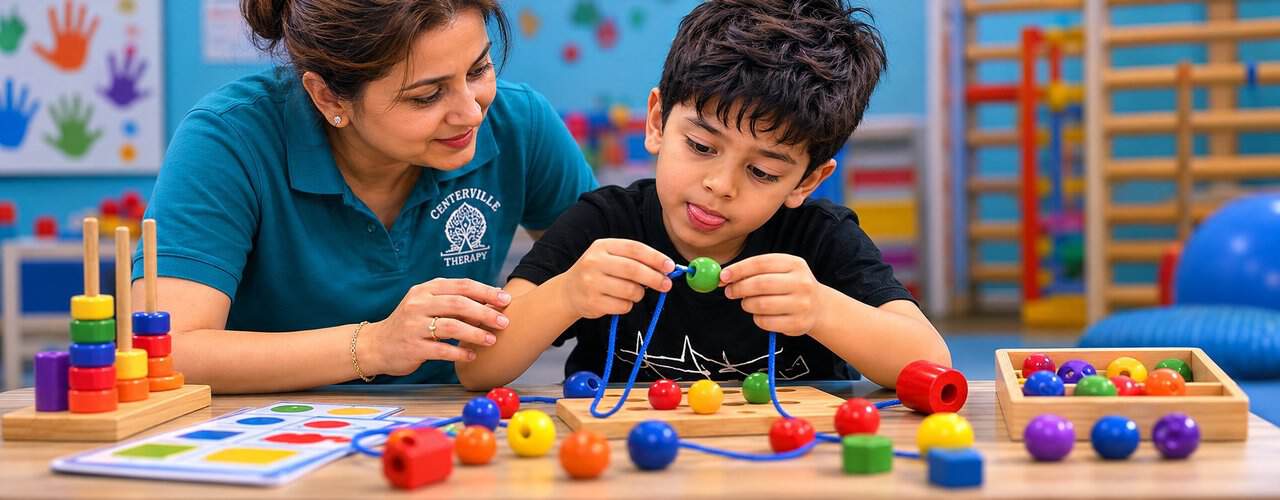
Sessions are play-based but deliberate. Obstacle courses that demand novel movement combinations. Body-awareness games that improve the child’s internal map of where their limbs are. Imitation games that build the brain’s ability to copy and modify movements. Strength work that gives the body something stable to plan against. Fine motor activities designed to demand specific finger and hand movements. Each piece is tied to a clinical goal, and we adjust based on what the child responds to.
We also work explicitly on the emotional layer. Children with dyspraxia often arrive convinced their body has failed them. Part of our job is rebuilding the belief that they can learn new movements — not by ignoring the difficulty, but by giving them deliberate, structured success.
Parents and caregivers become a critical part of the therapy team. We send home specific activities, coach you on how to set up the home environment to support practice, and help you advocate for accommodations at school when they are needed.
Related areas of practice
- Motor planning — the foundational skill that dyspraxia affects
- Fine motor delays — frequently co-occurs
- Handwriting problems — common with dyspraxia
- Sensory processing — proprioceptive challenges often present
- Return to sports — helping dyspraxic kids find physical activities they can succeed in
Recommended Reading
Deepen your understanding with these related articles from our health blog:
Frequently asked questions
What is dyspraxia in plain language?
Dyspraxia is a brain-based difficulty with planning and executing new physical movements. Children with dyspraxia have typical intelligence and want to do the things their peers do — but their bodies need extra help to learn how. It is sometimes called developmental coordination disorder (DCD) in formal diagnosis.
Is dyspraxia the same as autism?
No, but they can co-occur. Dyspraxia is specifically a motor coordination condition; autism is a broader neurodevelopmental pattern that includes social communication, sensory processing, and behavioral features. Some autistic children also have dyspraxia; most children with dyspraxia do not have autism.
Can dyspraxia be cured?
The underlying brain pattern does not change, but a child\’s functional ability changes substantially with targeted therapy. Many children with dyspraxia grow into adults who manage just fine — sometimes with adaptive strategies for specific tasks, often with confidence built from years of having been supported well.
Why is my child labeled as clumsy by teachers and coaches?
Children with dyspraxia look uncoordinated and take longer to learn new physical skills. Without an understanding of the underlying condition, teachers and coaches default to “clumsy” or “not trying hard enough.” Part of what we do is help families educate the people in their child\’s life and advocate for accommodations.
Does dyspraxia run in families?
Research suggests a genetic component — dyspraxia is more common in families where another member has the condition, dyslexia, ADHD, or autism. The exact inheritance pattern is not fully understood, but having a child with dyspraxia is not your fault.
This page was reviewed by Chandana Dash, OTR/L, who has practiced pediatric occupational therapy for more than 32 years. She specializes in family-centered care for children with sensory, developmental, motor, and neurodevelopmental challenges. She is the co-founder of Synergy Therapeutic Group in Carbondale, Illinois.
What is dyspraxia in children?
Dyspraxia — also called Developmental Coordination Disorder (DCD) — is when a child brain has trouble planning and coordinating movement. Affects 5–6% of children. Kids with dyspraxia often appear clumsy, struggle with handwriting, have trouble with self-care tasks, and avoid physical activities even though they are not lazy or unmotivated.
Is dyspraxia the same as autism?
No, though some children have both. Dyspraxia affects motor planning specifically. Autism affects social communication, sensory processing, and behavior more broadly. The two share some overlap (sensory issues, motor coordination difficulties), which is why proper evaluation matters.
Can children outgrow dyspraxia?
Dyspraxia does not disappear, but children develop strong compensation strategies and many skills with OT. Adults with dyspraxia often do very well in life — they just developed their own ways to navigate motor tasks. Early OT speeds the skill-building and prevents the frustration of falling behind peers.
This page is for general education, not medical advice. Everyone’s body and history are different — for guidance on your specific situation, talk with a licensed physical or occupational therapist. Synergy Therapeutic Group · 1110 N Cedar Court, Carbondale, IL 62901 · (618) 243-7822.