

Key Takeaways
- ADHD affects about 1 in 9 children. The inattentive type, often called ADD, is missed most often in quiet kids.
- ADHD is not a discipline problem. It is a difference in attention, impulse control, and executive function.
- Many children with ADHD also have sensory regulation differences, which is where occupational therapy helps.
- Therapy focuses on practical skills: getting started, staying with a task, managing frustration, and daily routines.
Reviewed by Chandana Dash, OTR/L — Co-founder, Synergy Therapeutic Group
Attention deficit hyperactivity disorder (ADHD) and attention deficit disorder (ADD) are neurodevelopmental conditions affecting attention, impulse control, executive function, and often sensory regulation.
It affects approximately 1 in 9 children in the United States, with three presentations: predominantly inattentive (often called ADD), predominantly hyperactive-impulsive, and combined type. The most common signs are difficulty sustaining attention, easily distracted, impulsivity, fidgeting or restlessness, trouble following multi-step instructions, and challenges with self-regulation in everyday life.
Unlike conventional approaches that focus solely on medication or behavior management, Synergy Therapeutic Group supports children with ADHD/ADD by addressing the sensory-motor systems underneath attention — body awareness, sensory regulation, executive function — giving the child concrete tools they can use throughout the day.
Your child is not lazy, defiant, or out of control. The regulation system that should help them stay focused is asking for support.
ADD and ADHD are usually framed as attention disorders. That framing is incomplete. What looks like a focus problem is almost always a regulation problem — the child’s brain and body cannot reliably get into and stay in the right state for the task in front of them. Some kids are stuck in low arousal and look spacey or unmotivated. Others are stuck in high arousal and look impulsive, reactive, or constantly in motion. Both patterns share the same root issue: regulation.
Why occupational therapy belongs in the ADHD picture
Medication and behavioral therapy are the standard medical responses to ADHD. They help some children significantly. They do not always address the sensory, motor, and regulation foundations that drive the symptoms. Occupational therapy works on those foundations directly.
A child whose vestibular and proprioceptive systems are underactive may need constant movement to feel regulated — and looks like ADHD in a classroom where they have to sit still. A child whose sensory system is over-reactive may be exhausted from filtering input and looks distracted because their attention budget is already spent. A child with poor motor planning gets frustrated with tasks that require coordinated movement and looks impulsive when they bail on those tasks. Each of these patterns responds to OT work that ADHD medication and behavior charts cannot fully reach.
How ADHD shows up
ADHD presentations vary widely. Some children are constantly in motion, can’t stay seated, blurt out, and have big emotional swings. Others are quiet and inwardly distracted — daydreaming through class, losing things, missing instructions. Many have a mix. Sleep is often poor. Transitions are hard. Homework drags on for hours. Friendships sometimes suffer.
What every ADHD presentation has in common is a regulation system that does not consistently match the child’s effort to the demand of the moment. The child is not choosing to be off-task. The system is not delivering the focus and arousal the moment requires.
How we approach ADHD at Synergy
An evaluation looks at the regulation system as a whole. We assess sensory processing, motor coordination, postural control, attention patterns, and the daily routines that either support or undermine regulation. We listen to what is working and what is not at home and at school.
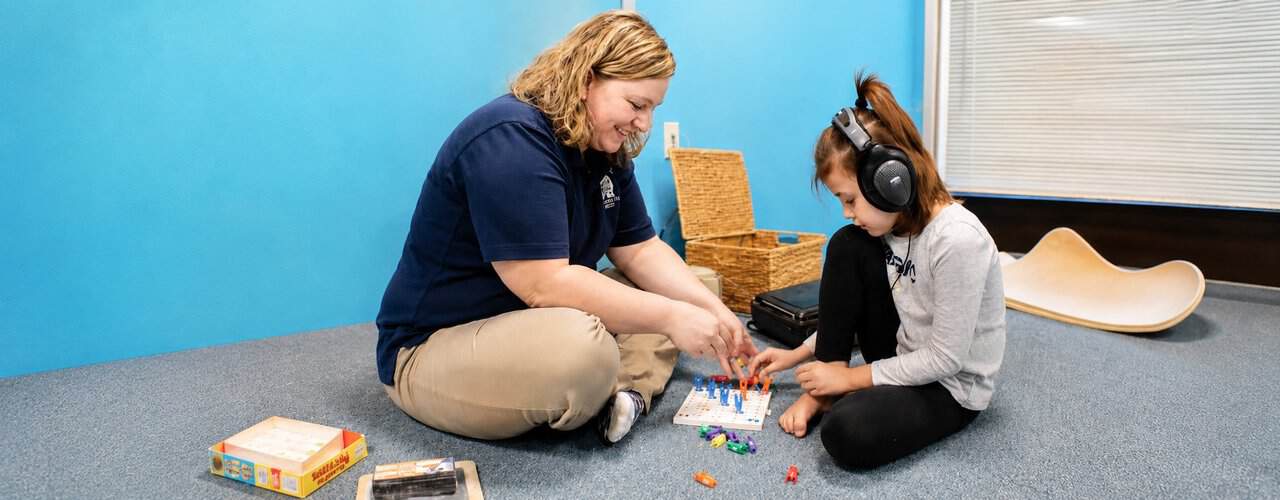
Therapy is play-based and targeted. We use activities that provide the kind of sensory input the child’s nervous system needs — heavy work and proprioceptive activities for kids who need calming and grounding, vestibular input for kids who need alerting. We build executive-function skills through structured play that demands planning, sequencing, and follow-through. We coach parents on the daily routines — sleep, meals, screen use, movement breaks, transition rituals — that make regulation more achievable.
For children already on medication, OT is complementary. The medication may make the child more available to do the foundational work, and the foundational work may eventually reduce the dose the child needs. That coordination happens with your physician.
Related conditions and overlaps
ADHD rarely shows up alone. Most children we evaluate for attention have one or more of the following alongside it. Treating the bundle gives better outcomes than treating attention in isolation:
- Sensory processing differences — almost always part of the picture
- Motor planning challenges — often underlie the “impulsive” pattern
- Autism spectrum — significant overlap with ADHD presentations
- Learning disabilities — frequently co-occur
- Handwriting problems — common in inattentive ADHD
Recommended Reading
Deepen your understanding with these related articles from our health blog:
Frequently asked questions
Can occupational therapy replace ADHD medication?
For some children, yes; for many, it complements medication. OT addresses the sensory, motor, and regulation foundations that medication cannot directly reach. Medication decisions belong with your physician — we work alongside the prescribing team.
How young can ADHD be evaluated?
Reliable ADHD evaluation typically happens around age 4 to 5, when sustained attention and impulse control should be measurable. Earlier sensory and regulation work can be done at any age — the diagnosis can wait until evaluation is appropriate, while the foundational therapy benefits begin much sooner.
What is the difference between ADD and ADHD?
ADD (attention deficit disorder) is older terminology for what is now usually called ADHD predominantly inattentive type — children who are inwardly distracted, daydreamy, slow to start tasks. ADHD with hyperactivity describes the more visibly impulsive, in-motion presentation. Both share the underlying regulation pattern.
Will my child grow out of ADHD?
For some children, symptoms become more manageable in adulthood; for others, ADHD continues to require support through adolescence and adulthood. The pattern often shifts rather than disappears — overt hyperactivity may decrease while inattention persists. Early therapy gives children tools they carry forward, regardless of how the pattern evolves.
Why does my child with ADHD constantly seek movement?
Many children with ADHD are seeking sensory input that helps their nervous system regulate. Movement, deep pressure, and proprioceptive input are calming and organizing for them — not just distracting fidgeting. Rather than suppressing the seeking, we usually channel it through purposeful activities that satisfy the need.
This page was reviewed by Chandana Dash, OTR/L, who has practiced pediatric occupational therapy for more than 32 years. She specializes in family-centered care for children with sensory, developmental, motor, and neurodevelopmental challenges. She is the co-founder of Synergy Therapeutic Group in Carbondale, Illinois.
How can occupational therapy help a child with ADHD?
OT addresses the everyday challenges ADHD brings: sensory regulation (calming an over-stimulated nervous system), executive function (planning, organizing, time management), fine motor difficulties (handwriting, getting dressed), and emotional regulation. We do not replace medication or behavior therapy — we add a layer most ADHD treatment misses.
Does OT include sensory diet strategies for ADHD?
Yes. Many children with ADHD have sensory components — they need movement, deep pressure, or specific input to regulate. We assess what your child nervous system needs and build a “sensory diet” of activities (heavy work, swinging, deep pressure) that help them focus.
Will my child outgrow ADHD?
ADHD is lifelong, but how it shows up changes with age and skill-building. Children who develop strong executive function, self-regulation, and accommodation strategies often do very well into adulthood. Our work is not about eliminating ADHD — it is about building the toolkit so your child thrives.
This page is for general education, not medical advice. Everyone’s body and history are different — for guidance on your specific situation, talk with a licensed physical or occupational therapist. Synergy Therapeutic Group · 1110 N Cedar Court, Carbondale, IL 62901 · (618) 243-7822.