

Key Takeaways
- Fine motor delays affect the small, precise hand movements behind writing, buttoning, and using utensils.
- Hand skill is built on shoulder and core stability, so we often start further up the body than parents expect.
- Avoiding coloring, fasteners, or utensils is usually difficulty, not stubbornness.
- Fine motor skills respond well to therapy, especially when practice is built into everyday routines at home.
Reviewed by Chandana Dash, OTR/L — Co-founder, Synergy Therapeutic Group
Fine motor delays involve difficulty with the small precise movements of the hands and fingers needed for tasks like grasping, writing, buttoning, and using utensils.
It affects children with sensory processing differences, motor planning challenges, low muscle tone, prematurity, or general developmental delays — and many children whose fine motor development simply lags behind their peers. The most common signs are awkward grasp patterns, dropping objects, difficulty using scissors or buttons, slow self-care skills, and frustration with school-related fine motor tasks.
Unlike conventional approaches that practice the same difficult task on repeat, Synergy Therapeutic Group treats fine motor delays by building the foundation underneath the hand — core and shoulder stability, sensory awareness, and bilateral coordination — so the small precise movements have what they need to develop.
Your child’s small hands have big work to do. When fine motor development lags, almost everything else gets harder. The good news: fine motor skills respond beautifully to targeted play.
Fine motor skills are the small, precise movements of the fingers, hands, and wrists. They are also the gateway to almost every skill children need to function independently — feeding themselves, dressing, writing, using technology, building, drawing, fastening clothing, opening containers, using utensils, playing. When fine motor development is behind, the consequences ripple out across the child’s day.
What fine motor development actually requires
Strong fine motor control is built on several less-visible foundations. These include:
- Hand strength — the small muscles of the hand need to be strong enough to grip, pinch, and sustain pressure
- Finger isolation — being able to move one finger independently of the others
- Pincer grasp — picking up small objects between thumb and forefinger
- In-hand manipulation — moving an object within one hand (rotating a coin, shifting a pencil from grasp to writing position)
- Bilateral coordination — both hands working together with different roles (one stabilizes, the other manipulates)
- Visual-motor integration — the eyes guiding the hand precisely
- Postural stability — a stable shoulder and trunk so the hand can do fine work without recruiting the whole arm
A delay in any one of these undermines the rest. Children with broad fine motor delay usually have weaknesses in several of these foundations at once.
How fine motor delays show up
Parents notice these patterns at different ages:
- Toddler: trouble using a spoon, stacking blocks, picking up small foods, pointing
- Preschool: difficulty with scissors, holding a crayon, coloring within lines, doing puzzles, opening containers
- Kindergarten: messy or labored writing, trouble with buttons and zippers, avoiding fine motor tasks
- School age: handwriting fatigue, difficulty using utensils efficiently, struggling with shoelaces and clothing fasteners, slow at fine motor tasks compared with peers
What is consistent across ages: the child often avoids fine motor tasks rather than struggle with them visibly. This avoidance can look like laziness or distractibility. It is usually the body opting out of a task it does not yet have the foundation to handle.
How we build fine motor skills at Synergy
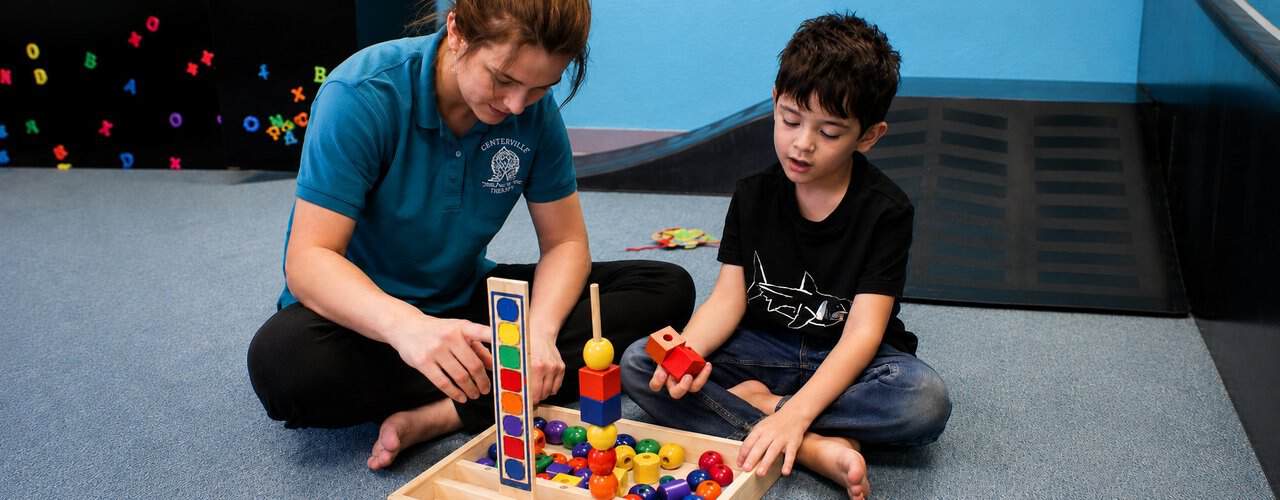
Therapy for fine motor delay does not look like worksheets. It looks like play that is deliberately designed to demand specific movements. Pinching clothespins onto a basket. Squeezing eyedroppers to move colored water. Rolling and pulling Theraputty. Building with small construction toys. Cutting paper with safety scissors. Threading beads onto string. Each activity targets a specific component of the fine motor system, and we sequence them based on what your child’s evaluation showed.
We also work on the postural foundations that fine motor skills depend on — core strength, shoulder stability, body awareness — because trying to develop fine motor control without those foundations is like trying to write a letter while sitting on a wobbly stool.
And we coach you — the parent — on the everyday activities that build the same systems. Cooking together (stirring, pouring, cutting soft foods with a butter knife). Dressing practice with manageable challenge. Climbing, hanging, swinging — activities that build the strength and stability the hand needs from a few joints further up.
Related areas
- Handwriting problems — fine motor is the foundation
- Motor planning — fine motor sequences require both strength and planning
- Sensory processing — proprioception in the hand drives precision
- Developmental delays — fine motor is a milestone area
- Dyspraxia — often presents with fine motor difficulties
Recommended Reading
Deepen your understanding with these related articles from our health blog:
Frequently asked questions
At what age should a child use a pincer grasp?
A refined pincer grasp — picking up small objects between thumb and forefinger — typically develops between 9 and 12 months. If your child is meaningfully past 12 months and not yet pincing, an evaluation is worth considering.
Why is my child still using a fist grip on the pencil?
Persistent fist or palmar grip beyond preschool age usually reflects underlying weakness in the small muscles of the hand, finger isolation difficulty, or poor proprioceptive feedback from the hand. The child is using a stronger grip pattern because the more refined pattern is not yet available — and therapy builds the foundations to make it available.
When should I worry about fine motor delays?
Specific milestones to watch: pincer grasp by 12 months, scribbling by 18 months, drawing recognizable shapes by 3 to 4 years, functional scissor use by 4 to 5 years, ability to form most letters by mid-kindergarten. Meaningful delays in these milestones — particularly multiple delays together — warrant an evaluation.
Can fine motor delays affect academic performance?
Yes — significantly. Almost every academic task involves fine motor skills: writing, drawing, manipulating math tools, using a tablet or keyboard, organizing materials. A child whose fine motor system is taxed by these basic mechanics has less attention left for the academic content itself.
What is the difference between fine motor and gross motor skills?
Gross motor uses large muscle groups for whole-body movements — running, jumping, throwing, climbing. Fine motor uses the small muscles of the hands and fingers for precise tasks — writing, buttoning, manipulating small objects. Both develop on parallel timelines, and a child can have strength in one while struggling in the other.
This page was reviewed by Chandana Dash, OTR/L, who has practiced pediatric occupational therapy for more than 32 years. She specializes in family-centered care for children with sensory, developmental, motor, and neurodevelopmental challenges. She is the co-founder of Synergy Therapeutic Group in Carbondale, Illinois.
What are signs of fine motor delays in children?
Trouble with: holding a pencil correctly past age 5–6, using scissors, buttoning, zippering, opening containers, building with small blocks, stringing beads, drawing shapes age-appropriately, or using utensils efficiently. Frustration with art and craft activities is often the first sign parents notice.
At what age should I be concerned about my child fine motor skills?
Major worry signs: not pointing by 12 months, not stacking blocks by 18 months, not scribbling by 2 years, not drawing a circle by 3, not holding a crayon with thumb and fingers by 4, not cutting with scissors by 5. If your child is 6+ months behind multiple milestones, talk to a pediatric OT.
How long does it take to improve fine motor skills?
Most children show meaningful improvement within 3–6 months of weekly OT plus home practice. Significant changes (independence with daily tasks like dressing) typically take 6–12 months. Early intervention is faster — building skills before they fall further behind peers.
This page is for general education, not medical advice. Everyone’s body and history are different — for guidance on your specific situation, talk with a licensed physical or occupational therapist. Synergy Therapeutic Group · 1110 N Cedar Court, Carbondale, IL 62901 · (618) 243-7822.