
By Subrat Bahinipati, PT, Physical therapist and co-founder, Synergy Therapeutic Group, Carbondale, Illinois · 30+ years treating chronic and complex pain
Clinically reviewed by Subrat Bahinipati, PT on · Last updated
Key Takeaways
- I am trained in dry needling. I used it for years, then stopped, and I no longer keep the equipment.
- I didn’t stop because it doesn’t work. I stopped because I found that myofascial release, for the patients I treat most often, worked better.
- Dry needling treats the spot. Myofascial release works the whole pattern that keeps re-creating the spot.
- Research backs both, differently: needling is well studied and mostly short-term; myofascial release has fewer trials, but the ones that exist are encouraging.
- I trained in the John F. Barnes Myofascial Release Approach: the method built for people whose pain did not respond to everything else.
- If you were about to book dry needling, talk to me first. Same conditions, gentler tool.
Every week someone calls my clinic with the same question: “Do you do dry needling?”
They expect me to say yes. Instead I tell them something that usually stops the conversation: “I’m trained in dry needling. I used it for years. Then I stopped.”
There’s usually a long pause. Then: “Why would someone stop using something they spent time and money learning?”
That’s exactly the right question, and the honest answer is the whole point of this article. Let me say the most important part first, so there is no confusion: I didn’t stop using dry needling because it doesn’t work. I stopped because I found that myofascial release, for the patients I treat most often, worked better. This is not a therapist dismissing something he never learned. I learned it, I used it on real people, and I chose to move past it.
What Dry Needling Actually Does Well
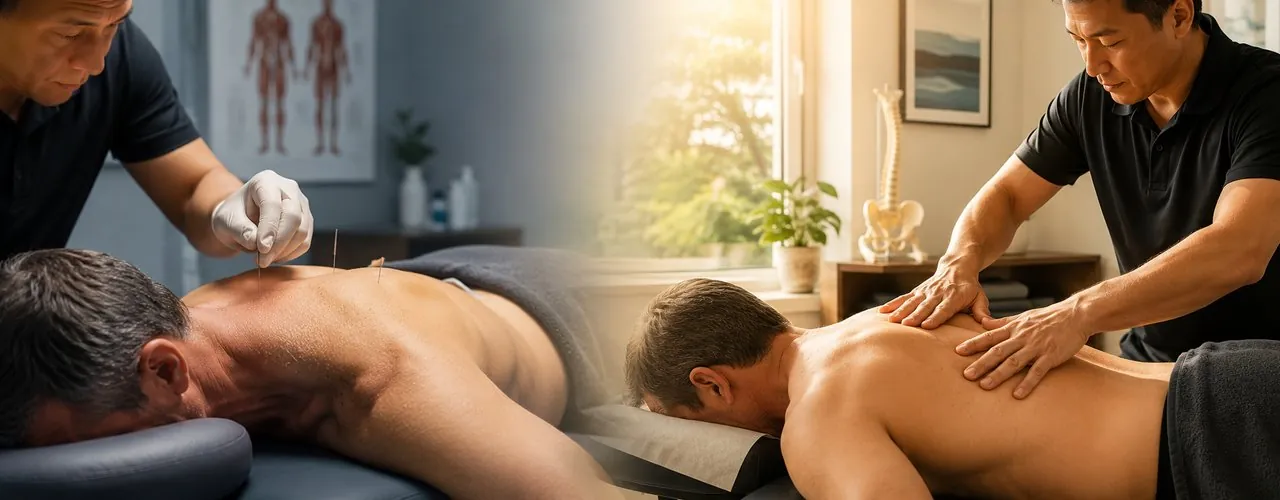
A thin filament needle goes into a trigger point: the tight, ropey band inside a muscle. The muscle twitches, and often it lets go. Patients frequently feel looser walking out than walking in. That is real, and I am not going to pretend otherwise. As trigger point therapy for chronic muscle pain, it can genuinely quiet an angry muscle.
The research agrees. A large umbrella review pooling 36 systematic reviews found dry needling beats sham or no treatment for short-term pain, and performs about the same as other hands-on treatments. So needling works. The question is what happens after.
Why I Stopped Using It
For a while I accepted that this was simply how chronic pain worked. Treat the trigger point. The patient feels better. A few weeks later it comes back. Repeat.
Then one day I realized I had stopped asking the most important question. Why did that muscle tighten in the first place?
Dry needling did its job on the muscle. But so many of my chronic pain patients kept coming back with the same pattern that I finally had to ask myself: was I treating what was actually driving the problem, or just one place it kept showing up? A needle answers the what. It does not answer the why. And if you never answer the why, the patient stays in a loop (relief, return, relief, return) which is exactly the cycle most of my chronic pain patients are already exhausted by when they find me.
Why the Pain Is Rarely Where It Hurts
Let me show you what I mean, because a story lands where an explanation doesn’t.
One woman came to me because of neck pain. Every therapist before me had treated her neck. Massage. Exercises. Needling. Heat. Nothing lasted. When I examined her, the biggest restriction wasn’t in her neck at all, it was through her rib cage and upper back. As those tissues released, her neck stopped working so hard.
That experience wasn’t unique. I see versions of it every week. Sometimes the shoulder is being pulled by restrictions through the chest. Sometimes the low back is compensating for an old ankle injury nobody connected to it. Sometimes the headache begins with tension that starts much lower than the head. That is why I stopped chasing symptoms, and why a neck problem so often turns out to be driven by somewhere else entirely.
Dry Needling vs Myofascial Release: Two Different Questions
So here is the honest difference, without overstating it.
Dry needling works on the spot. It targets specific trigger points and tight bands, using a needle to provoke a muscle response. The relief is real but often temporary. It can leave soreness or bruising. In a survey of 420 physical therapists covering more than 20,000 needling sessions, 36.7 percent of treatments caused a minor side effect, most often bleeding, bruising, or pain during the needling. Serious problems were rare. For a lot of people the needles themselves are a barrier. Most of all, it works on a small area rather than the system that area belongs to.
Myofascial release works on the pattern. It is hands-on manual therapy that works the fascia: the connective tissue that wraps every muscle and links every part of you to every other part. Restrictions in that web pull on structures far from where you actually hurt. There is no needle, and most people find it calming rather than painful. Because it addresses the whole pattern, the change tends to hold.
The Approach Behind the Hands
The Barnes approach was designed around a question that mattered to me: what do you do for the people who have already tried everything else? Those are the patients I see every day: people who have had injections, surgery, therapy, medication, and are still living with pain. That is why I kept studying this approach. I trained in the John F. Barnes Myofascial Release Approach, I have practiced it for many years, and I still take the courses again whenever time allows, because this work keeps showing you more the longer you do it. Chandana trained in it too, and we have both kept at it.
I did not start out this way. I trained as a conventional physical therapist, grounded in traditional, research-based practice. That is the lens I was given. And I will be honest about how long it took me to change it. I took my first Barnes course a long time ago and then I stopped: what I saw in that room did not fit the training I already had, and part of what held me back was fear: what would my colleagues think? So I put it down, did some work on myself, and picked it back up. I am glad I did. Every patient I have been able to reach since is the reason: especially the ones who had already been told there was nothing more to try.
What the Research Says. Honestly
You deserve the straight version more than a sales pitch. Myofascial release is studied less than dry needling: fewer trials, smaller trials. But the studies that exist are encouraging: a systematic review and meta-analysis found myofascial release significantly improved pain and physical function in chronic low back pain, and a separate review found moderate evidence for improvements in pain, sleep, and quality of life in fibromyalgia.
And here is the fair, scientific way to hold all of this: many aspects of the interaction between the nervous system, connective tissue, stress, and persistent pain are still being investigated. Some areas have good evidence. Others are promising but not yet well understood. I will never tell you something is proven when it is not, but I will also not withhold a process I have watched help people for decades simply because a trial has not yet been built to measure it. Much of this work is individual by nature: every session changes with the body in front of me. Until the research catches up, my evidence is more than twenty years of it and thousands of people in Carbondale who walked out moving better than they walked in.
What Treatment Actually Feels Like
People often imagine myofascial release is simply massage. It isn’t. The pressure is slow: sometimes almost still. Instead of forcing tissue to stretch, I wait for the restrictions to soften and unwind. Patients often notice areas releasing that they didn’t even realize were connected. Many leave saying, “I feel lighter,” or “I can turn farther,” or “my shoulder suddenly feels different.” The treatment is surprisingly gentle. The effects can be surprisingly profound.
The Part Patients Have to Own
I tell everyone the same thing, so I will tell you here too: I can change the tissue, but you have to change what keeps re-creating the problem: how you sit, how you sleep, how you move through an ordinary day. When we release the root pattern and you follow through on that piece, the relief holds. That is the honest deal, and it is the part a needle can never give you.
If You Came Here Looking for Dry Needling
Talk to me first. I have done both. I chose to stop for a reason, and I would rather spend five minutes explaining what is actually happening in that muscle than send you off for a treatment I moved past. You can read more on the dry needling and myofascial release pages, or about the wider approach to chronic pain.
When I stopped doing dry needling, I wasn’t walking away from a technique. I was walking toward a different philosophy. Instead of asking, “Where does it hurt?” I started asking, “Why is your body protecting this area in the first place?” That question changed the way I practice. More importantly, it changed the results my patients experience.
If you’ve spent years collecting temporary fixes, maybe it isn’t because your body is broken. Maybe nobody has been treating the pattern that’s been driving your pain all along. That is where our work begins.
Thinking about dry needling? Talk to me first.
As a chronic pain specialist in Carbondale, IL, I treat the same trigger-point and chronic muscle pain with hands-on myofascial release, and look for the pattern driving it, for adults across Southern Illinois.
Frequently Asked Questions From My Patients
Do you offer dry needling at Synergy?
No. I am trained in it and used it for years, but I stopped and no longer keep the equipment. I treat the same trigger-point and muscle pain with hands-on myofascial release.
Is dry needling the same as acupuncture?
No. Dry needling targets muscle trigger points using Western anatomy. Acupuncture works with energy meridians from traditional Chinese medicine. The needles look similar, but the thinking behind them is completely different.
Does myofascial release hurt?
There is no needle, and most people do not get the next-day soreness that needling can cause. You will feel firm, deep pressure. Most patients describe it as “that is the exact spot” rather than painful.
If dry needling works, why not use both?
Because I found I could get the same muscle to release with my hands, without a needle, while also treating the pattern that tightened it in the first place. Once that was true, the needle was no longer adding anything.
How many sessions before I notice a difference?
It depends how long the pattern has been building. Some people feel a real shift in the first visit or two. Long-standing problems take longer. I will tell you honestly after I evaluate you.
Will the results last?
When we treat the root pattern and you follow through on the daily habits we talk about, yes. That combination is what makes the change hold.
Subrat Bahinipati, PT, is a physical therapist with more than 30 years of experience specializing in chronic pain and integrative healing. He is trained in the John F. Barnes Myofascial Release Approach and is co-founder of Synergy Therapeutic Group, 1110 N Cedar Court, Carbondale, IL.
Your body is not broken, it is adapting. We call our approach Whole Body Synergy Techniques: we look at how the whole body is compensating, not only at the spot that hurts. When you are ready to talk it through, request an appointment online or learn about the Synergy Healing Program.
This article is for medical information and education only. It is not medical advice, and it does not replace an evaluation by your physician or a licensed physical therapist. Every person is different, so please talk to your healthcare provider about your own situation. If you have severe, sudden, or worsening symptoms, or any concern about your health, contact your physician or seek urgent care. Synergy Therapeutic Group, 1110 N Cedar Court, Carbondale, IL 62901, (618) 243-7822.
See more of our articles in Google
If this was worth your time, you can tell Google you want to hear from us. It takes one tap, and it makes our articles more likely to turn up the next time you search for answers about pain, movement, or your child’s development.