
Key Takeaways
- Lymphedema is swelling from fluid that cannot drain well, most often in an arm or leg. It can follow cancer treatment, surgery, injury, or appear with no clear cause.
- Having had cancer does not mean you will get lymphedema, and lymphedema is not only a cancer problem.
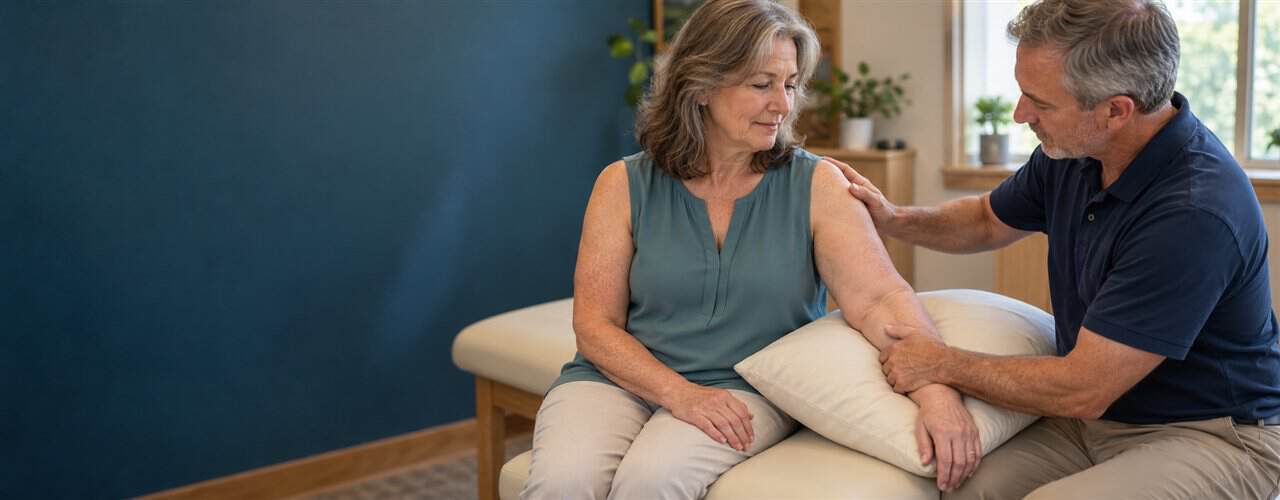
- Our approach is whole-body physical therapy: gentle hands-on work on the connective tissue, movement, and breathing, not only the swollen area.
- We do not provide manual lymphatic drainage or compression wrapping. Our care can complement your existing lymphedema treatment.
- After cancer, our clinic requires clearance from your surgeon or oncologist before we treat you.
Lymphedema is the build-up of protein-rich fluid in the tissues of an arm, leg, or other area when the lymphatic system cannot carry it away well enough.
Over time the trapped fluid can bring inflammation, scarring (fibrosis), and fat deposits in the tissue (StatPearls). The limb feels heavy, tight, and full, and it becomes harder to use.
At Synergy Therapeutic Group in Carbondale, IL, we look at the swollen area and at the connective tissue, movement, and breathing of the whole body around it.
Your arm or leg feels heavy and swollen. Looking only at the swollen part may not be enough.
So if you have lymphedema, you probably have been given the standard plan: manual lymphatic drainage, compression wraps or a garment, exercise, and skin care. For many people that care is important, and I want to say that plainly. This page explains the different service we offer, and how it can sit alongside what you already do.
One thing first, so there is no confusion. I am not a certified lymphedema therapist. We do not provide manual lymphatic drainage or compression wrapping. If you want that care, a certified lymphedema therapist is the right place, and if you already have one, please keep that care unless your doctor says otherwise.
Who gets lymphedema
Most of the people who come to me with lymphedema are after cancer treatment, often breast cancer, when lymph nodes were removed or radiated. But not everyone who has had cancer gets lymphedema, and not everyone with lymphedema has had cancer. I also see it after surgery, after an injury, and sometimes it simply appears. I have seen it in both arms and legs. If your swelling is new or you do not know why you have it, it needs a medical assessment first, because infection, a blood clot, vein problems, lipedema, heart or kidney conditions, and medications can also cause swelling. A doctor should confirm the diagnosis. If you have had cancer and notice new swelling, tell your oncologist.
Why I look at the connective tissue
Lymph vessels do not float on their own. Fluid reaches them through the connective tissue, the web of fibers and fluid between our tissues. The 2018 research on the interstitium described these fluid-filled spaces in more detail, and a 2023 study in the journal Life found lymphatic vessels inside the superficial fascia (abdominal tissue from three people). That anatomy is why I examine fascia in people with lymphedema. It does not, by itself, prove that any treatment works.
Here is what I have seen in my patients over more than 25 years. In many people with a swollen, heavy arm, the chest, upper back, neck, and abdomen are also tight. With a swollen leg, I often find the hip, pelvis, and low back involved. This is a pattern I look for in each person, not something I assume. When it is there, the limb is used less, and reduced movement can add to the fluid build-up. So I treat the whole pattern, not only the swollen part.
What the research says so far
I want to be straight with you. Myofascial release has been studied in breast cancer-related lymphedema, and the results are mixed. In a 2023 crossover trial of 30 patients, everyone also received standard decongestive therapy. Arm volume improved in both groups with no significant difference, but pain and most shoulder movements improved more with myofascial release than with a placebo version, while shoulder function scores did not differ (trial). In a 2025 trial of 98 women after breast surgery and radiation, only some of whom had lymphedema, myofascial release did better than manual lymphatic drainage for shoulder pain, movement, function, and quality of life over one month (trial). That trial did not measure swelling.
The studies discussed here support benefits for pain and movement, but do not establish that myofascial release adds swelling reduction beyond standard care. They also did not test my whole-body approach as I deliver it. What I offer comes from clinical experience, and I check each person’s response as we go.
How I evaluate lymphedema
I start with your history: when the swelling began, what surgery, radiation, injury, or illness came before it, what you have tried, and what your doctors have told you. If you have had cancer, I ask for clearance from your surgeon or oncologist before we treat you. That is a requirement of our clinic. Then I look at the whole body, not only the swollen limb: where the fascia is tight, how the neck, chest, spine, and abdomen are holding, and how you breathe, move, and use the limb.
To know whether care is helping, we pay attention to how heavy, tight, or painful the limb feels, how well you move, and how you manage everyday tasks like dressing, reaching, or walking, and we compare from visit to visit. We also measure swelling with a tape measure, taking girth measurements around the limb at set points, which is a standard physical therapy tool. Feeling looser and measured swelling are different things, and I will tell you which one we are seeing.
How we treat lymphedema
Our care is gentle and should not be painful. It usually includes:
- Gentle myofascial release of connective-tissue restrictions identified during your evaluation, which may include the affected limb, chest, spine, neck, abdomen, hips, or pelvis
- Movement and breathing work, so the limb is used and the tissue keeps moving
- Home guidance on movement and self-care, and our wellness program to support you afterward
About compression. We do not provide compression wrapping. A wrap or garment may need to come off in the area we are treating so we can reach the skin and the tissue underneath. Putting it back on follows the plan your doctor or lymphedema therapist has given you, and if we think a change is needed, we coordinate it with the clinician managing your care. If you are in the bandaging phase of treatment, check with your lymphedema therapist before your visit.
About laser. As a clinic policy, we do not use laser for anyone with a cancer diagnosis, past or present.
We will not do hands-on work on a limb with an active infection, an untreated blood clot, or active cancer in that area. I cannot promise a timeline or a result, and I cannot promise that this work will reduce your swelling. I will tell you honestly what I find and what I think is realistic.
When you need a doctor first
Redness, warmth, or a rash spreading on a swollen limb, with or without fever or flu-like feelings, can be an infection (cellulitis) and needs same-day medical care. Sudden new swelling, or swelling in one arm or leg with pain, can be a blood clot and cannot wait. If you also feel very unwell, confused, have a racing heart, fast breathing, chest pain, or sudden shortness of breath, call 911 or go to the emergency room.
What to expect, step by step
New or unexplained swelling gets a medical check. After cancer, we need clearance from your surgeon or oncologist.
Your history, how the neck, chest, spine, abdomen, and hips hold, how you move, and tape-measure girth measurements of the limb.
Gentle myofascial release plus movement and breathing work. It should not be painful.
We compare how the limb feels, how you move, and the measurements from visit to visit, and guide you at home.
When you should come see us
- You have been told to wear the garment and manage it, and you want to understand more about what else is going on
- Your arm or leg feels heavy, tight, and hard to use
- You have tightness in the neck, chest, back, or hip that seems connected to the swelling
- You want someone to look at the whole body, not only the swollen limb
- You have had cancer treatment and your doctor has cleared you for physical therapy
Ready to talk?
Call us at (618) 243-7822 or request an appointment online to schedule an evaluation. Our staff will help you with the next step, including any clearance we need from your surgeon or oncologist.
Request Appointment Call (618) 243-7822
Conditions connected to lymphedema
- Myofascial release — the core of our approach
- Shoulder pain — common after breast surgery and radiation
- Neck pain — the neck and chest often tighten with a swollen arm
- Wellness program — support for continued movement and self-care
Recommended Reading
Deepen your understanding with these related articles from our health blog:
Frequently asked questions
Do you do manual lymphatic drainage or compression wrapping?
No. I am not a certified lymphedema therapist, and we do not provide manual lymphatic drainage or compression wrapping. If you want that care, a certified lymphedema therapist is the right place. Our service is whole-body physical therapy, and some patients use both.
Do I need clearance from my doctor?
If your lymphedema is after cancer, our clinic requires clearance from your surgeon or oncologist before we treat you. We can help you ask for it.
Is the treatment painful?
It should not be. Our hands-on work is gentle. Tell us right away if anything is uncomfortable.
Can I keep wearing my compression garment?
Follow your doctor’s or lymphedema therapist’s instructions. It may need to come off in the area we are treating so we can reach the skin and tissue underneath. Putting it back on follows the plan your doctor or lymphedema therapist has given you, and any change is coordinated with the clinician managing your care. If you are in the bandaging phase, check with your lymphedema therapist before your visit.
Why do you look at more than the swollen arm or leg?
Connective tissue is continuous, and in many of my patients I find tightness in the chest, spine, neck, or abdomen along with a swollen arm, or in the hip, pelvis, and low back along with a swollen leg. Reduced movement can contribute to fluid build-up, so we look at the whole pattern in each person.
Do you use laser for lymphedema?
As a clinic policy, we do not use laser for anyone with a cancer diagnosis, past or present.
What should I do if my swelling suddenly gets worse?
Redness, warmth, or a spreading rash on the swollen limb, with or without fever, needs same-day medical care because it can be an infection. Sudden new swelling, or swelling in one arm or leg with pain, can be a blood clot. If you also feel very unwell, confused, have a racing heart, fast breathing, chest pain, or sudden shortness of breath, call 911 or go to the emergency room.
This page is for general education, not medical advice. Everyone’s body and history are different. Synergy Therapeutic Group does not replace care from your physician or a certified lymphedema therapist. Synergy Therapeutic Group · 1110 N Cedar Court, Carbondale, IL 62901 · (618) 243-7822.