By Subrat Bahinipati, PT, Physical therapist and co-founder, Synergy Therapeutic Group, Carbondale, Illinois · 30+ years treating chronic and complex pain
Clinically reviewed by Subrat Bahinipati, PT on · Last updated
Key Takeaways
- Class 4 laser therapy can genuinely help with pain, some injuries, and certain wounds. But it is not magic, and it rarely works on its own.
- “Class 4” is a power and safety category, not a promise. Wavelength, dose, treatment area, and clinical judgment decide the benefit, not wattage alone.
- It works best as part of a plan. Laser calms the pain and supports healing. Then hands-on care and rehab can fix what actually caused the problem.
- It is very safe (safe enough for selected children (no growth-plate concern like some other modalities)) but never used carelessly, especially with a history of cancer.
- In Illinois you can start physical therapy without a referral. Laser is usually out of pocket; we tell you the cost first.
Short answer: Yes. Class 4 (deep tissue) laser therapy can genuinely help with pain, some injuries, and certain wounds. Research supports its use for conditions such as tendinopathy, frozen shoulder, knee arthritis, and plantar heel pain. But it is not magic, and it rarely works on its own. In more than 30 years using therapeutic laser, I have found it works best as one part of a complete plan, alongside hands-on care and rehab. It is never a substitute for proper diagnosis.
Hi, it’s Subrat.
So right now, all over Southern Illinois, people in their 50s, 60s, and 70s are out on the pickleball court. And I love it: people moving, competing, laughing, and feeling athletic again. But here is what I am also seeing in my clinic lately. The ankle that rolls. The shoulder that flares up. The tennis elbow that will not settle. And the Achilles that suddenly starts talking back. A 2026 study of pickleball injury visits at one large healthcare system found that 62% of the injured patients were aged 50 to 69.
And almost every one of them asks me the same thing: “Subrat, can the laser help me?”
So I want to talk to you honestly about laser therapy. What is it? What can it do? What can it not do? And why is the machine we use different from what most clinics have? There is a lot of confusion out there.
First. Let Me Clear Up the “Laser” Confusion
When most people hear “laser therapy,” they picture the little cold laser: the low-level one. And I understand why, because that is where all of this started.
When I trained in physical therapy in Kolkata, India, from 1988 to 1994, we used a German-made helium-neon laser. By today’s standards, it was very low-powered, about half a watt. Treatment was slow, and the amount of energy we could deliver was limited.
But the technology has changed. A lot. Today’s therapy lasers can deliver 15, even 20 watts. Lasers at this higher output fall into the Class 4 safety category. So are a cold laser and a Class 4 laser the same thing? No. A Class 4 system can deliver more energy over a larger area in a practical amount of time. Depending on its wavelength and dose, it can treat deeper targets more effectively.
But I do not want to repeat the marketing language you see everywhere online. “Class 4” is a power and safety classification. It is not a promise that the machine will reach an exact number of centimeters, or that it will work better for every patient. Wavelength matters. Dose matters. Your tissue and medical history matter. And the person choosing and operating the laser matters most of all.
We have a Class 4 deep tissue laser at Synergy Therapeutic Group here in Carbondale, Illinois. These systems are expensive. That is one reason they are not in every clinic. But owning an expensive machine does not make a treatment plan.
Why I Love This Tool
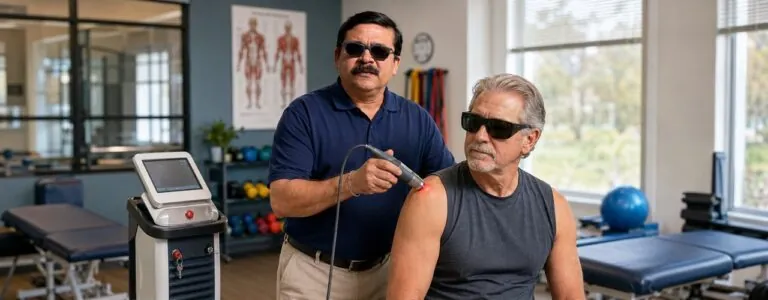
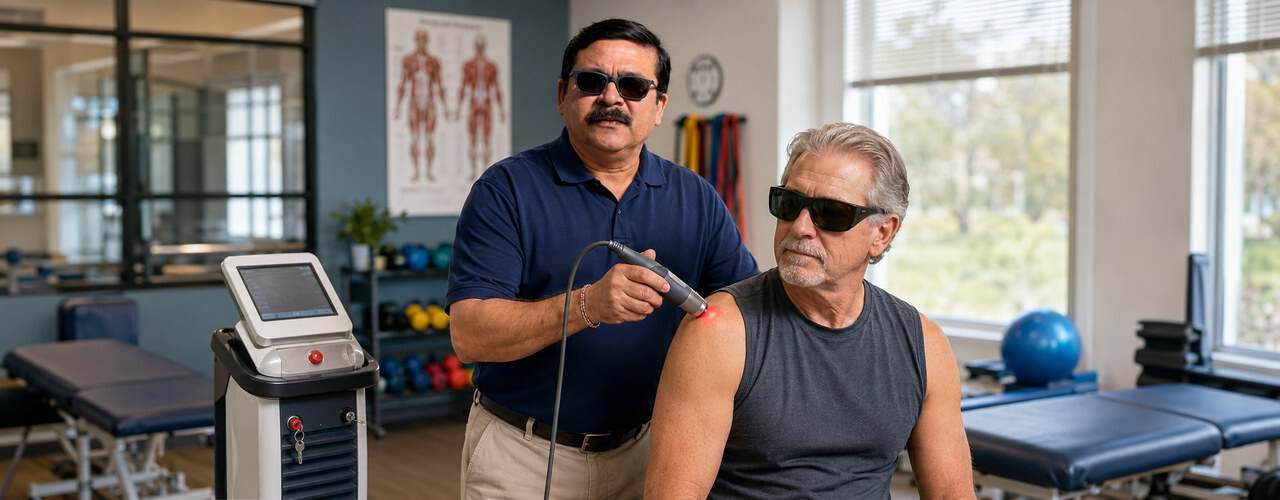
So why do I like laser so much? First, when it is properly screened and used with the right eye protection, it is one of the safest and gentlest tools I have used in more than 30 years of practice. Most people feel nothing more than a comfortable warmth. Second, it can calm pain and irritation without a needle, an injection, or medication. And third, sometimes it gives me an opening.
Maybe your shoulder hurts so badly that you will not let me move it. Maybe your heel hurts so much that every step changes the way you walk. Then we first need to turn down some of that irritation. When laser helps the area become less painful, I can begin the hands-on treatment and movement your body needs. That is why I like laser. It can open the door, but we still have to walk through it.
What about children and their growth plates?
This matters to families. I have used therapeutic laser carefully with selected children for many years. I have never personally observed a growth-plate problem. That is my clinical experience. But I am not going to tell a parent that research has proved zero risk for every child, every dose, and every device. Pediatric research is more limited than adult research. I consider the child’s age, diagnosis, and treatment area. I follow the instructions for that particular device. And I check whether the child can wear the safety glasses and tell me what they feel. I believe laser can be a safe, gentle option for selected children. I also believe it should never be used casually just because it is non-invasive.
Is Laser Therapy Safe If You Have Cancer? The One Situation That Always Makes Me Stop
Here is where I want to be very honest, because this is how you know you are in careful hands. If there is a known or suspected tumor in or near the treatment area, I do not simply “put the laser on it.” Laser changes cell activity and supports the processes involved in repair. Its effects around tumor tissue are not fully settled.
If someone has a history of cancer, I slow down. I want to know what type it was, whether it is active, where it was, what treatment they had, and what their oncology team recommends. Sometimes I will not use laser. In other situations I may consider it only after coordinating with the physician. A past history of cancer is not the same as treating directly over an active tumor. In fact, major cancer centers use this therapy under controlled protocols for selected problems caused by cancer treatment. But I would rather be cautious than gamble with someone’s health.
I also stop and investigate when I suspect a fracture, tendon rupture, serious infection, blood clot, or another problem that laser cannot diagnose or fix.
What Does the Research Actually Say?
There is research supporting laser therapy for pain and function in problems such as tendinopathy, frozen shoulder, knee arthritis, some neck and back pain, plantar heel pain, and myofascial pain.
A 2024 umbrella review examined 20 previous systematic reviews. It found encouraging pain results for several muscle and joint conditions. It also found that many of those reviews were of low or critically low quality.[1] A systematic review and meta-analysis of laser for lower-limb tendon problems and plantar heel pain found improvements in pain and disability. The biggest benefit came when laser was added to exercise, though doses and study quality varied.[2] And a network meta-analysis of laser combined with exercise for knee osteoarthritis found real benefit for pain and function. High-intensity laser showed somewhat greater long-term improvement than low-level laser, though both helped.[3]
So what does that mean? It means laser is a legitimate clinical tool. It does not mean the machine will heal every injury, that high power always wins, or that everybody responds the same way.
And this is where clinical experience matters. Research tells us what happened, on average, across a group of patients under one protocol. Clinical practice shows me what happened to the person standing in front of me. A patient story is not a randomized trial. I understand that. But if I watched something happen, I am not going to pretend it did not happen simply because nobody has completed the perfect study yet. Research has not proved it. That is not the same as saying it never happened. I will tell you what I observed. I will also tell you honestly what I cannot prove.
A Wound That Should Not Have Healed on Its Own
So let me tell you about a gentleman in his late 80s who was already coming to me for therapy. He tripped over his dishwasher and tore open the front of his leg. This was not a scratch, it was a deep gash that took skin and damaged some of the tissue underneath.
And what did he do? He did not go to the emergency room. He said, “No, tomorrow I have my therapy appointment. Subrat will take care of me.” When I saw his leg, my first response was not, “Let’s use the laser.” My first response was, “You should have had this looked at.” A wound like that can hide deeper damage, germs, infection, or a circulation problem. Laser should never be an excuse to delay the medical care a wound needs.
The wound was clean and did not appear infected. His doctor evaluated it and gave him an antibiotic as a precaution. We coordinated his care, monitored the wound, and made laser part of the plan. But let me be clear about that antibiotic: it did not grow back the missing skin and tissue. Antibiotics treat infection; they do not create new tissue, restore circulation, or close a clean wound.
And this was not my first difficult wound. Over more than 30 years I have treated wounds that had already been classified as non-healing for longer than a year. Some were in areas with poor circulation, where the tissue had very little of what it needed to repair itself. So I know what a stalled wound looks like. And based on this gentleman’s age, the depth of the injury, and the amount of tissue lost, I did not expect it to close easily on its own.
We used laser, protected the wound, and watched it carefully. And then I watched it change: healthy tissue filling the area, the edges coming together, and the wound closing and recovering remarkably well for a man his age. His doctor saw the progress and told him, “Keep doing whatever you are doing. It is healing well.” Did the laser alone heal him? His body did the healing, and the wound was protected and medically monitored. But can I truthfully say I watched a serious wound close while laser was a central part of the plan? Yes. That is exactly what happened. And it changed how I think about this tool.
Research on laser for wound healing is encouraging in some types of wounds (studies show faster closure and less pain), but protocols and results vary. It belongs beside proper wound care, never instead of it.[4] If you have a deep, gaping, dirty, infected, or non-healing wound, do not book a laser appointment instead of having it checked. Get the right medical and wound-care team involved first.
I Watched Her Fracture Heal. Week by Week
So let me tell you one more, and this one is personal. My family and I were on vacation outside the country. My wife, Chandana (who is also our pediatric occupational therapist here at Synergy) tripped and injured her ankle. I had seen enough injuries to suspect she had broken something. We wrapped it, protected it, kept her off the foot, and had it evaluated when we returned home. The X-ray confirmed a stable hairline fracture.
From the day we landed, I gave her laser almost every day at home (alongside the rest of her care, not instead of it. Over the next four weeks, we had follow-up X-rays. And I could see it) week by week, the bone was healing, faster than I personally expected. Remember, Chandana is a clinician herself. She understood the injury, the uncertainty, and exactly what she was choosing.
Can I prove the laser caused the faster progress? No. I cannot separate it from the stability of the fracture, the protection we used, her health, and the normal healing ability of her body. But that is what I watched happen, with the films in my hand. And I will be straight with you about the science, too. Current research on laser and human fracture healing is mixed. A recent review found possible short-term pain benefit but no consistent evidence that laser speeds bone union.[5] That does not erase what I observed. My honest conclusion is not, “Laser heals every fracture faster.” It is this: what I saw was real and encouraging. Laser may have contributed, but it never replaces getting a fracture properly diagnosed, protected, and managed.
What I Learned Treating My Daughter
And it is not only Chandana. My daughter (who is now studying to become a Doctor of Physical Therapy) ran cross-country for years. If you have ever run competitively, you know ankle sprains come with it. She rolled hers many times, sometimes just days before a big meet. Again and again, we used laser as part of her recovery, and I watched her pain and swelling settle faster than I expected.
But (and this is important) I never cleared her to race just because the ankle felt better after laser. Pain relief can show up before strength, balance, tissue tolerance, and confidence are ready. Laser may help you move sooner. Rehab is what makes the return safe. That is a rule I followed with my own daughter, so you know I will follow it with you.
The Truth: Laser Alone Is Usually Not Enough
So now you might be thinking, “Great, I will just go get some laser and I am fixed.” And I have to be honest with you, because many clinics will not tell you this. In many places, you lie down, someone runs the laser over the painful area, and then you leave. Yes, laser by itself may calm pain, sometimes quickly.
But with muscle and joint pain (the pickleball shoulder, the bad back, the tennis elbow, or the plantar heel) the pain is only one part of the problem. Why did that heel become overloaded? Is your ankle stiff? Is your calf weak? Has the pelvis changed how you load that leg? Why did the shoulder flare up? Is the upper back stiff? Is the shoulder blade moving poorly? Laser can calm the irritated area. It cannot answer those questions or perform the rehabilitation for you.
So what do we do differently? We evaluate the whole person, not only the painful spot. When laser is appropriate, we use it to reduce pain and support healing. Then we combine it with hands-on manual therapy, myofascial release, mobility work, strengthening, balance training, and changes in how you load the area. The laser helps calm the tissue. The rest of the treatment addresses the factors that keep overloading it. In my clinic, this is when I see the best results. Some research also finds better pain results when laser is combined with exercise or other physical therapy. The evidence is not equally strong for every condition.[2][3]
Laser is not the engine. It is the accelerator for the right plan.
What Treatment Feels Like
Most patients feel a gentle, soothing warmth as the treatment head moves over the skin. There are no needles and no incision. Treatment time depends on the condition, area, and dose: a larger hip or low back is not treated the same way as a small elbow or ankle. A Class 4 laser can injure the eyes or skin if it is misused. So everybody in the treatment area wears laser-specific safety glasses. We watch your comfort, skin response, and heat throughout the session. You can normally return to your daily activities right afterward. But feeling better right away does not always mean the tissue is ready for full activity. That decision is based on function, not only pain.
What This Means for You in Carbondale
If you call Synergy and ask for laser, I am not going to promise the machine will fix you. First, we look at what is actually happening. If laser is the right tool, we use it. If another treatment is more important, I will tell you. If I believe you need an X-ray, a wound specialist, an orthopedic evaluation, or another medical opinion, I will tell you that too.
The number of treatments depends on the condition and how your body responds. More treatment is not automatically better. I do not believe in continuing any treatment forever when it is not producing a real change. Laser therapy is often not covered by insurance, so it may be an out-of-pocket service. We will explain the cost before treatment. And in Illinois, you can begin physical therapy without a physician referral. Some insurance plans may still require one for payment.
So, Does Class 4 Laser Therapy Really Work?
I have used therapeutic laser since 1989. I would not have kept using it all these years if I did not believe it helped people. I have watched painful joints move more easily. I have watched athletes recover. I have watched wounds that had not healed for more than a year finally begin to change. I watched a serious wound close in a man in his late 80s. I watched my wife’s fracture progress on X-ray. And I have used this tool with my own family, not because I believe it is magic, but because I understand both its value and its limits.
Those observations are real. But I will not turn them into a promise that every person will heal faster or that laser alone will correct the whole problem. The best question is not, “How powerful is your laser?” The better question is, “Is laser the right tool for my problem, and what else does my body need?” That is what we will help you find out.
Ready to find out whether laser belongs in your plan?
At Synergy Therapeutic Group in Carbondale, IL, we combine Class 4 deep tissue laser therapy with hands-on care and rehab built around you, when it fits your needs. You do not need a referral to begin physical therapy in Illinois, you can book directly or call us.
Request an Appointment or call (618) 243-7822
1110 N Cedar Court, Carbondale, IL 62901
Frequently Asked Questions
What is Class 4 laser therapy?
Class 4 laser therapy (a form of photobiomodulation, sometimes called high-intensity or deep tissue laser therapy) uses a higher-powered therapeutic laser, often 15 to 20 watts, to deliver light energy into tissue to help reduce pain and support the body’s natural healing. “Class 4” is a power and safety classification, not a promise of results; wavelength, dose, treatment area, and clinical judgment determine the benefit.
Is Class 4 laser therapy the same as cold laser therapy?
No. Class 4 lasers operate at a higher output and can deliver more energy over a larger area in less time. But Class 4 is a power and safety category, not proof that one machine is best for every condition. Wavelength, dose, treatment area, and clinical judgment all matter.
Does Class 4 laser therapy hurt?
Most people feel only gentle warmth. It should not feel burning or sharply painful. Protective eyewear is required, and the therapist should monitor your comfort and skin response throughout treatment.
How quickly will I feel a difference?
Some patients report less pain or easier movement during the first few sessions. Others improve more gradually, and some do not respond. The result depends on the diagnosis, stage of healing, dose, medical history, and treatment performed alongside the laser. No responsible clinician should promise how quickly your body will change.
Can laser therapy heal a fracture or torn tendon?
Laser cannot stabilize a fracture or reconnect a ruptured tendon. It may sometimes be used as an addition to proper medical and rehabilitative care, but it cannot replace diagnosis, imaging, protection, immobilization, or surgery when those are needed.
Can laser therapy help a non-healing wound?
Photobiomodulation has been studied as an adjunct for selected wounds, and I have personally treated wounds classified as non-healing for more than a year. But the cause of the stalled healing must be evaluated: infection, poor circulation, pressure, diabetes, nutrition, and other factors may all need treatment. Laser should support appropriate wound care, not replace it.
Is laser therapy safe if I have had cancer?
I do not treat over or near a known or suspected tumor. A past history of cancer requires individual review, because cancer type, current status, treatment area, and oncology guidance all matter. When appropriate, I coordinate with the person’s physician before making a decision.
Does insurance cover Class 4 laser therapy?
Often it does not, so the treatment may be self-pay. Coverage varies. We will explain the cost before treatment so there are no surprises.
Do I need a referral for physical therapy in Illinois?
Illinois permits physical therapy with or without a referral. Some insurance plans may still require one for coverage, and Illinois law includes circumstances in which your therapist must communicate with or refer you to another healthcare professional.
Your body is not broken, it is adapting. We call our approach Whole Body Synergy Techniques: we look at how the whole body is compensating, not only at the spot that hurts. When you are ready to talk it through, learn about the Synergy Healing Program.
Subrat Bahinipati, PT, is co-founder of Synergy Therapeutic Group in Carbondale, Illinois. He has practiced physical therapy for more than 30 years. He first used therapeutic laser in 1989 while training at the National Institute for the Orthopaedically Handicapped (now the National Institute for Locomotor Disabilities) in Kolkata, India, under the University of Calcutta. His work focuses on chronic pain, manual therapy, myofascial treatment, neurological rehabilitation, and understanding the whole person, not just the painful body part.
References
- Quality appraisal of systematic reviews on high-intensity laser therapy for musculoskeletal pain management: an umbrella review. Lasers in Medical Science (2024).
- Naterstad IF, Joensen J, Bjordal JM, et al. Efficacy of low-level laser therapy in patients with lower-extremity tendinopathy or plantar fasciitis: systematic review and meta-analysis of randomised controlled trials. BMJ Open 2022;12(9):e059479.
- Efficacy of high-intensity and low-level laser therapy combined with exercise therapy on pain and function in knee osteoarthritis: a systematic review and network meta-analysis. PMC (2024).
- The effects of low-level laser therapy on wound healing and pain management in skin wounds: a systematic review and meta-analysis. PMC (2024).
- Effect of photobiomodulation on pain relief and functional improvement in fractures: a systematic review and meta-analysis. Annals of Medicine (2026).
Medical disclaimer: This article shares clinical experience and general educational information. It does not replace a medical evaluation, diagnosis, or treatment made for you. Serious wounds, suspected fractures, tendon ruptures, infections, blood clots, and medical emergencies need prompt medical care. If you are experiencing a medical emergency, call 911.
This article is for medical information and education only. It is not medical advice, and it does not replace an evaluation by your physician or a licensed physical therapist. Every person is different, so please talk to your healthcare provider about your own situation. If you have severe, sudden, or worsening symptoms, or any concern about your health, contact your physician or seek urgent care. Synergy Therapeutic Group, 1110 N Cedar Court, Carbondale, IL 62901, (618) 243-7822.
See more of our articles in Google
If this was worth your time, you can tell Google you want to hear from us. It takes one tap, and it makes our articles more likely to turn up the next time you search for answers about pain, movement, or your child’s development.