

Key Takeaways
- Handwriting difficulty affects 10-30% of school-age children, more often in kids with ADHD, dyspraxia, or sensory differences.
- Messy handwriting is rarely about effort. It usually comes from fine motor, visual-motor, or postural challenges underneath.
- Pain or fatigue while writing, and avoiding writing altogether, are signs worth having evaluated.
- Handwriting still matters. It activates motor, visual, and thinking systems together in a way typing does not.
Reviewed by Chandana Dash, OTR/L — Co-founder, Synergy Therapeutic Group
Handwriting problems in children involve difficulty forming letters, controlling the pencil, or producing legible written work — often rooted in underlying fine motor, visual-motor, or sensory challenges.
It affects approximately 10-30% of school-age children, with greater prevalence in children with ADHD, dyspraxia, sensory processing differences, or low muscle tone. The most common signs are illegible handwriting, awkward pencil grip, fatigue or pain during writing, slow writing speed, avoidance of writing tasks, and frustration at school.
Unlike conventional approaches that focus only on handwriting drills, Synergy Therapeutic Group treats handwriting problems by addressing the foundational systems — postural control, shoulder and hand strength, visual-motor integration, and sensory regulation — that handwriting depends on.
If your child’s handwriting is messy, slow, or painful, they are not careless. The body is asking for support.
Handwriting looks simple. It is not. To write legibly, a child’s body has to coordinate the fingers, the wrist, the shoulder, the trunk, the eyes, the visual-motor system, and the brain regions that translate idea into letter shape — all at the same time, while staying focused on what they are trying to say. When any of those systems is underdeveloped, handwriting struggles. Often the child looks like they are not trying. They are trying very hard. The body just is not ready yet.
What handwriting difficulty actually means
Most children we evaluate for handwriting are not lacking effort. They are lacking one or more of the foundational systems that handwriting requires. These include:
- Hand strength and finger isolation — the ability to use just the fingers without recruiting the wrist or arm
- Proprioception — knowing where the hand is in space without looking at it
- Visual-motor integration — coordinating what the eyes see with what the hand does
- Bilateral coordination — one hand stabilizing the paper while the other writes
- Postural control — a stable trunk so the writing arm can move freely
- Motor planning — sequencing the movements needed to form each letter
- Attention and regulation — being calm enough to focus on the task
A child who struggles with handwriting is usually showing a gap in one of these — often more than one. Identifying which gap is what makes the therapy work.
What this looks like at home and at school
Parents notice handwriting struggles in several ways. The child grips the pencil too tight or too loose. They press too hard and tear the paper, or too softly and the writing is invisible. They form letters from the bottom up, or out of order, or with strange directions. Their letters do not sit on the line. Spacing is erratic — letters bunched up or scattered. They mix uppercase and lowercase mid-word. They get tired quickly. They avoid writing tasks altogether.
At school, the teacher may flag handwriting as a concern, or the child may simply be falling behind in tasks that require writing — and the teacher may assume the problem is attention or motivation when it is really the motor system.
How we work on handwriting at Synergy
We do not just have the child practice writing. That would be like trying to fix a wobbly tower by adding more stories. We work on the foundations first.
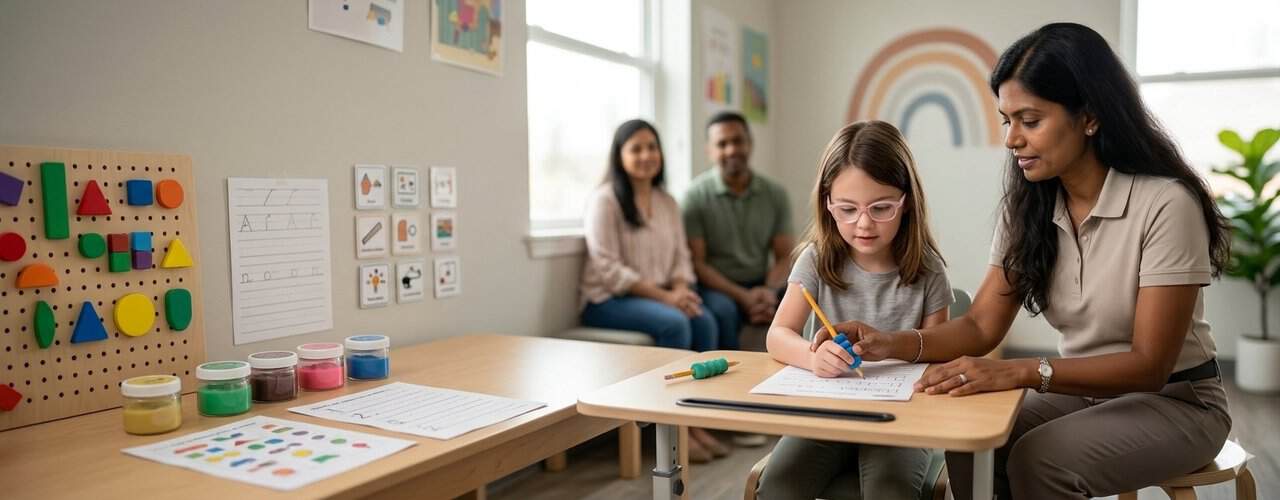
Sessions often include hand-strengthening play, fine motor activities that build pincer grasp and finger isolation, visual-motor games, bilateral coordination tasks, and postural and core work — all delivered through activities the child finds engaging. Once the foundations are stronger, the actual handwriting practice we layer on top sticks, because the child’s body can finally support it.
We also coach you — the parent — on the at-home activities that build the same systems in everyday play. Cooking together. Climbing. Building with small construction toys. Cutting paper. The right kinds of play in childhood are not extras. They are the curriculum the body needs.
Related areas we evaluate alongside handwriting
- Fine motor delays — the underlying system handwriting depends on
- Motor planning — sequencing letter formation
- Perceptual difficulties — visual processing for letter recognition
- Sensory processing — proprioception is a sensory system
- Learning disabilities — handwriting and reading often share underlying patterns
Recommended Reading
Deepen your understanding with these related articles from our health blog:
Frequently asked questions
Is bad handwriting a sign of a learning disability?
It can be, but it is not always. Persistent handwriting struggles past mid-elementary school — especially when combined with other patterns — can point to dysgraphia (a specific learning disability for writing). Many children with messy handwriting have fine motor, visual-motor, or motor planning gaps that respond to targeted therapy without a learning disability diagnosis.
At what age should handwriting be legible?
By the end of first grade, most children should be able to form letters consistently and write a simple sentence legibly. By third grade, handwriting should be fluent enough that it does not get in the way of expressing ideas. If your child is meaningfully behind these milestones, an evaluation is worth doing.
Can my child just use a tablet or laptop instead of practicing handwriting?
Technology accommodations are useful and increasingly common — and they are not a substitute. Research shows that handwriting activates motor, visual, and cognitive systems together in ways that typing does not, with measurable effects on reading comprehension and recall. The goal is usually both — handwriting skill plus appropriate keyboarding access.
Why does my child press too hard when writing?
Excessive pressure usually reflects proprioceptive challenges — the brain is not getting clear feedback about how much force the hand is using, so it overcompensates. It can also reflect general muscle weakness or anxiety about getting the writing right. Therapy works on the underlying system; the pressure adjusts as the system improves.
What is dysgraphia and how is it different from messy handwriting?
Dysgraphia is a specific learning disability affecting writing — including handwriting, spelling, and the process of putting thoughts on paper. It is more than just messy handwriting; it involves significant difficulty with the writing process despite typical intelligence and normal cognitive development. Dysgraphia often coexists with handwriting problems but the two are not the same.
This page was reviewed by Chandana Dash, OTR/L, who has practiced pediatric occupational therapy for more than 32 years. She specializes in family-centered care for children with sensory, developmental, motor, and neurodevelopmental challenges. She is the co-founder of Synergy Therapeutic Group in Carbondale, Illinois.
When should I worry about my child handwriting?
By age 6–7 (1st–2nd grade), most kids can form letters legibly, hold a pencil with a functional grip, and write a short sentence without major frustration. Worry signs: fatigue or pain after a few minutes, reversed or inconsistent letters, illegibility, avoidance of writing tasks, or comparison to peers showing your child is well behind.
What causes handwriting problems in children?
Many things contribute: weak fine motor skills, weak core (poor posture while writing), poor visual-motor integration, sensory processing issues, immature pencil grip, and lack of foundation skills (cutting, drawing). Handwriting is a complex skill — pinpointing the actual issue is where OT helps most.
How long does occupational therapy take to improve handwriting?
Most children show meaningful improvement within 3–6 months of weekly OT, especially when combined with home practice. Significant transformation typically takes 6–12 months. The earlier we intervene, the faster the gains — handwriting struggles in 1st grade are easier to fix than struggles in 5th.
This page is for general education, not medical advice. Everyone’s body and history are different — for guidance on your specific situation, talk with a licensed physical or occupational therapist. Synergy Therapeutic Group · 1110 N Cedar Court, Carbondale, IL 62901 · (618) 243-7822.