


Key Takeaways
- Carpal tunnel is where you feel it, not necessarily where it starts. The median nerve is squeezed at the wrist on the test, but the nerves to your hand begin in the neck and travel through the shoulder and arm.
- In 34 years I have never found that repetition alone injures a healthy body. The body is built to repeat. The better question is what changed in the body doing the work, and why now.
- In my experience the pattern begins with a postural change, and the change is mechanical. Women carry their weight in front of the chest, and over the years that pulls the thoracic spine forward. The shoulders round, and the shoulder blades and the muscles at the front of the neck and chest follow.
- Rounded shoulders change how the median nerve moves. In an ultrasound study, shoulder protraction cut the nerve’s movement in the arm by about 60% when the neck moved. A nerve that cannot glide is a nerve that struggles, and the wrist is where it often shows.
- That is why it so often moves from one hand to the other, and why a brace, or a surgery on one wrist, so often leaves the real cause untouched.
- We treat from the top down: the thoracic spine first, then the shoulder blade, then posture, then the wrist and hand only where they still need it.
At first it only happens at night. You wake up with numb fingers, shake your hand, change positions and try to go back to sleep.
Later you notice it while driving, holding your phone or working. Your grip is less dependable. A jar that opened easily last year is now a small battle. Perhaps the other hand has started too.
Then you hear the familiar explanation: “It’s carpal tunnel. You use your hands too much.”
But you have used your hands your whole life. So what changed, and why is it happening now? That question is where we begin.
You recognize the symptoms. You deserve an explanation.
Carpal tunnel syndrome means the median nerve is under pressure at the wrist. It can cause numbness, tingling, pain and weakness, especially in the thumb, index and middle fingers. Those symptoms are real, and I take them seriously.
What I question is the next step, the assumption that because the symptom is in the wrist, the problem must be in the wrist. The symptoms tell us something needs attention. They do not tell us the whole story.
Watch · under a minute
Why hand numbness often starts higher up
The numbness is in the hand. The cause often sits higher. Here is the chain.
The explanation I do not accept
“Repetitive injury” does not explain it
The standard teaching is that carpal tunnel comes from repetition: too much typing, too much gripping, too many years at the same job. I disagree, and I have for a long time.
In 34 years of practice I have never found that repetition, by itself, injures a healthy body. The body is made to repeat. Your heart does it, your lungs do it, your legs do it every step you take. If repeating a movement were enough to break a body, none of us would still be walking.
Think about the people who come to see me. Most have done the same work, or played the same hobby, for twenty or thirty years without a single numb finger. Then one year the hand goes numb. The job did not change. The body doing the job did.
There are cases where the wrist itself is the cause. A wrist fracture that healed out of position, for example, can narrow the space the nerve passes through. I do not dismiss that. But it is a small share of the people I see. Most are women, most have no fracture, and many tell me it started in one hand and then moved to the other. A mechanical problem at one wrist does not do that.
Think about a garden hose
Imagine you turn on the tap and the water barely trickles out of the end of the hose. Where do you look? You do not take the nozzle apart and stop there. You walk the length of the hose and look for the kink. It could be anywhere along the line.
A nerve test is a little like checking the water at the nozzle. It can confirm that the nerve is not conducting well across the wrist, and that is useful. But it cannot tell you why the nerve ended up struggling there, or whether the wrist is the only place it is struggling. Yet the moment the test comes back, everyone jumps to the wrist and nobody walks the hose.
Where it starts: from the top down
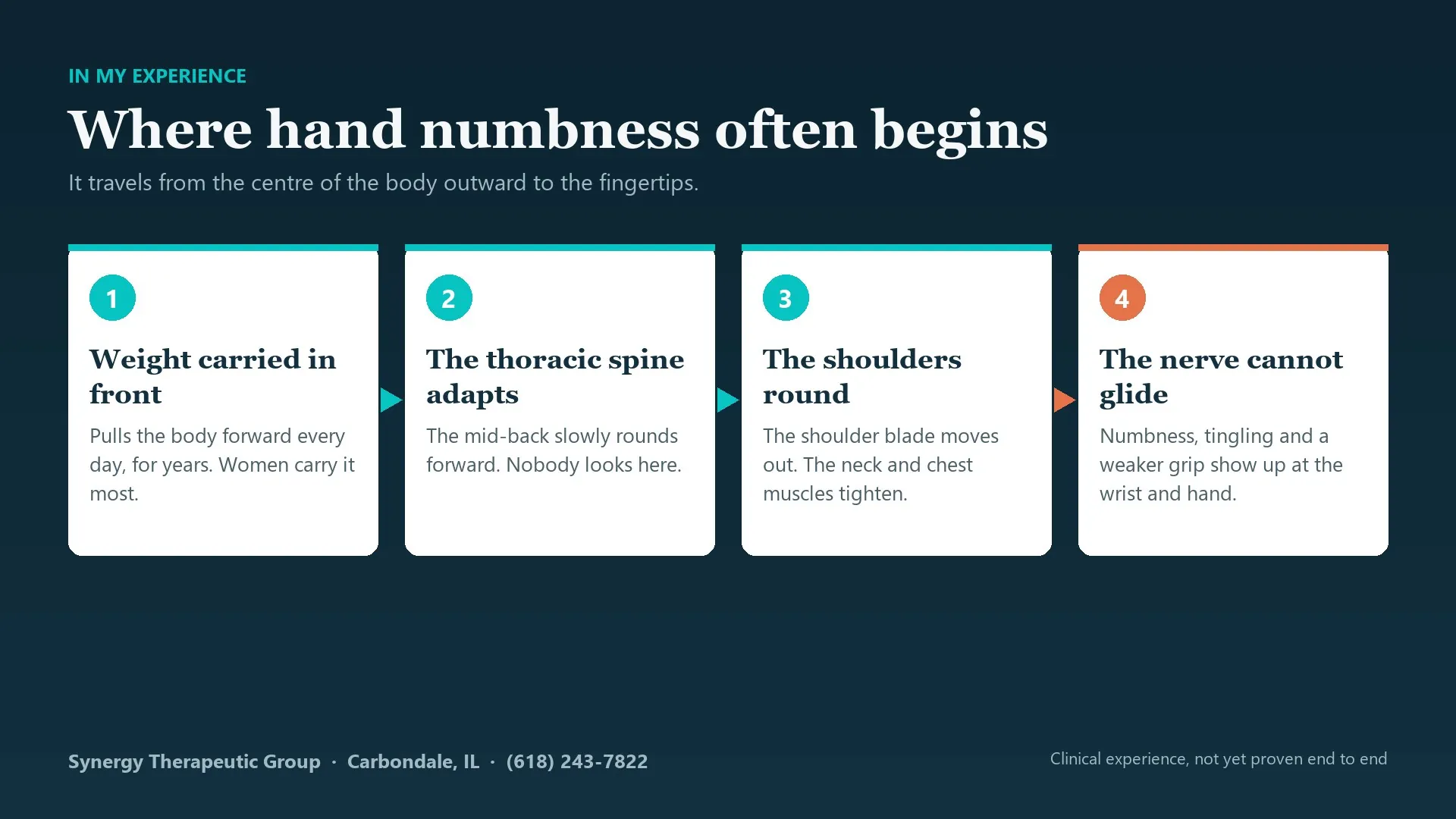
In my experience any pain or nerve symptom that shows up at the far end of the arm begins at the near end, in the body’s posture. It travels from proximal to distal, from the centre of the body outward to the fingertips.
Here is the pattern I find again and again, and I want to be exact about it, because the mid-back is where the change happens, not where it begins.
It begins with biomechanics. In women especially, the body carries its weight in front of the chest, including the weight of the breasts. Hour after hour, year after year, that load pulls everything forward. The body adapts, and the adaptation shows up in the thoracic spine, the mid-back, which slowly rounds forward. Almost nobody ever looks there. You will not notice it yourself, and it does not appear on a wrist exam.
Once the mid-back rounds, the shoulders round with it. The shoulder blade is pulled out of its place. The muscles at the front of the neck and chest, the scalenes, the sternocleidomastoid and the pectorals, get shorter and tighter. And that changes how the nerves of the arm move. They leave the neck through a small, crowded space beside those very muscles, then pass under the collarbone and the shoulder on their way down. A nerve is not meant to sit still. It is meant to glide as you move your neck, shoulder and arm. When the posture limits that glide, the nerve is the one that pays, and the far end of the pathway, the wrist and hand, is where you feel it.
Where it begins
Weight carried in front
The body’s load sits forward of the spine and pulls it forward, every day, for years. This is why I see it so much more in women.
Where the body adapts
Thoracic spine
The mid-back rounds forward. Nobody looks here, and everything above it inherits the curve.
What follows
Rounded shoulders
The shoulder blade moves out, the shoulder rolls in, and the front of the neck and chest tighten. The nerves can no longer glide as they should.
Where you feel it
Wrist and hand
Numbness, tingling, a weaker grip. The far end of a pathway that was already under strain.
I will say it plainly: this is my clinical experience, and it has not been proven in a laboratory. Nobody has funded a study that follows a woman’s posture from the front load to the thoracic spine to the nerve to the hand. What I can show you, in the section below, is that the links in that chain have research behind them, and that the pieces point the same way.
It also fits an older idea. Physical therapists call it regional interdependence: a problem in one region produces symptoms in a distant one. In nerves the idea has an older name. In 1973 two neurologists reported that a nerve squeezed in one place becomes more sensitive to pressure in another, and they called it the double crush. They found signs of a neck problem in most of the people they studied with carpal tunnel or ulnar nerve symptoms. It has been debated ever since, and I am not asking you to take it from the literature alone.
One more thing about all of this. Your body is not broken. It is adapting. Over years it has made a series of sensible changes to carry its load, and the hand is simply where the cost of those changes finally shows.
Why it moves from one hand to the other
If the cause lived in one wrist, it would stay in that wrist. When it starts in the right hand and, a year later, appears in the left, the common factor is not the wrist. It is the body that owns both of them.
I see this most often in women, and the reason is mechanical. The weight carried in front of the chest pulls both shoulders forward equally, so both sides are loaded the same way, for the same years. A brace on one wrist cannot protect the other, and neither can an operation on one wrist.
What you have been told vs. what I actually find
These two columns are the whole page in miniature.
The standard story
- Repetitive use injured the wrist.
- The problem is a tight tunnel at the wrist.
- So everything aims at the wrist: a brace, an injection, then surgery.
- If that fails, look at the elbow, then the shoulder, then the neck.
- Each stop treats one spot, one at a time.
What I find
- The body changed, and the hand is the last place the change shows up.
- Weight carried in front pulls the thoracic spine forward, and the shoulders round with it.
- Rounded shoulders limit how the arm nerves glide. Both hands share the same pathway, so the second hand follows the first.
- Start at the thoracic spine and shoulder blade, and the wrist often stops being the problem.
- Look at the whole pathway on the first visit, not the last.
Before another brace, injection or operation
The trail I have watched, again and again
I have followed this trail with patient after patient. A brace for one wrist, which does nothing. Surgery on that wrist. Then the other hand goes numb, so surgery on the other wrist. When that does not settle it, the elbow is released for the ulnar nerve. Then the shoulder. And more than once, years and several operations later, the neck.
By the end of it, after four, six or even eight procedures, the patient is often worse than when they started. Not because anyone was careless, but because every stop aimed at the spot where the symptom showed up, and the problem was never there.
This is not a reason to avoid surgery if your wrist truly needs it. It is a reason to ask one question before the next step: has anyone looked at the whole pathway, from the mid-back to the fingertips? If you have already had a carpal tunnel operation and the symptoms remain, that question matters even more. Persistent symptoms do not prove the first operation was wrong. They do tell us the picture is not complete yet.
What the research does and does not say
My theory has not been tested from start to finish, and I will not pretend it has. But each link has been looked at, and I would rather show you the research than ask for your trust. Here it is plainly, including where the evidence is thin.
- Weight carried in front is linked to hand-nerve symptoms. Two studies of women with very large breasts found carpal tunnel more often than expected. In one, 22% of 31 women had slowed median nerve conduction, against about 3% for women in general. In the other, 123 women, carpal tunnel went along with breast size and age but not with body weight. A year after breast reduction, nine of the fifteen women who were re-assessed had no symptoms or were better. Both studies are small and were done in women seeking surgery, so they point a direction, not a proof.
- Taking the front load away relieves upper-body pain. A 2026 review of 47 studies found that 90% of women had significant back pain relief after breast reduction, and the thoracic curve improved significantly. Here I will be honest: the measured change in the curve was small, about one and a half degrees, and another study found the forward lean differed only slightly from women without large breasts. I do not read that as ending the question. A few degrees on a photo does not capture how the shoulders, blade and neck actually carry load.
- Treating the thoracic curve helps. In a randomized trial of 80 people with long-term neck pain, adding treatment aimed at reducing thoracic hyperkyphosis improved neck pain and disability more than the same program without it, and the gain was still there a year later.
- Rounded shoulders change how the median nerve moves. In an ultrasound study, shoulder protraction cut the movement of the nerve in the arm by about 60% when the neck moved to the side. It was a small study in healthy volunteers, not patients, so it shows a mechanism, not a cause.
- Treating more than the wrist has been tested. In a randomized trial of 120 women with carpal tunnel, a short course of hands-on therapy that included the neck and the median nerve was compared with surgery. The therapy group did better at one and three months, and the two groups were similar at six and twelve months. A four-year follow-up found them similar on pain, function and self-rated improvement as well. It was a single hospital in Spain, so I do not oversell it.
- Where I go further than the literature: that the thoracic spine is where the change happens, that it starts with the load carried in front, and that repetition alone does not injure a healthy body. That comes from three decades of treating hands that other care left numb, including people who had already had several operations. I have not run a double-blind trial on it, but I have seen it too many times to call it a coincidence.
What treatment looks like here
Your first visit is an examination, not a handout. We test the wrist and hand, and we also look at the upper back, the neck, the shoulder blade and the arm, and we see which positions change what you feel.
When the findings point there, treatment begins at the thoracic spine, restoring motion to the mid-back. From there we release the soft-tissue restrictions in the shoulder, neck and chest, then help the shoulder blade sit and move where it can support the arm again, and then work on posture so the change holds. Only after that do we treat the wrist and hand where they still need it. At Synergy we call our approach Whole Body Synergy Techniques: we treat the person, not the symptom. Both of our founding therapists are trained in the John F. Barnes Myofascial Release Approach, which is central to how we release the connective-tissue restrictions along that whole pathway without forcing anything.
We measure progress in your life, not in a number. Can you sleep through the night? Hold the steering wheel without the tingling? Open the jar? Carry the groceries? Are the numb spells fewer and shorter? When we find where it starts, the hand usually follows. Results differ from person to person, and I will tell you honestly if the findings suggest you need a physician’s care instead.
You can read more about how we approach neck pain, shoulder pain, the same top-down thinking in our pages on tennis and golfer’s elbow and frozen shoulder, why headaches can begin in the neck, our adult occupational therapy, or what to expect on your first visit.
Patient success stories
“When I first came, my right arm was ‘numb’ and ‘ached’ especially at night. It would hurt and be so numb that it would wake me up out of sleep. … After one week the tingling and numbness was gone. … I had not realized how much I avoided using my right arm due to the pain, loss of strength and tingling.”
Linda · Royalton, IL
“I could not move my neck or shoulder, my hands were numb and I did not sleep well at all. After my first treatment, I could move my neck and look up and down. I did not have any numbness or pain at all. I can also be more physically active and enjoy gardening again.”
Carol · Marion, IL
“Came in the Fall of 2022. Had pain in neck and shoulders, the pain went down my arms. Now I’m pain free!”
Mark Horstmann · Read his story
Individual results vary. These are the experiences of specific patients and are not a prediction of your outcome.
Frequently asked questions about carpal tunnel and hand numbness
Will a wrist brace fix carpal tunnel?
A brace can calm the wrist for a few nights, and for some people that is enough to make the night bearable. But a brace only holds the wrist still. If the reason the nerve is struggling sits higher up, in the mid-back, the shoulder blade or the front of the neck, the brace is aimed at the wrong place. In my experience that is why so many people wear one faithfully for months and the numbness is still waiting for them in the morning.
My nerve test was positive. Doesn't that prove the problem is my wrist?
It proves the nerve is not conducting well across the wrist, and that is real information I take seriously. What it cannot tell you is why the nerve ended up there, or whether the wrist is the only place it is struggling. A test of the pipe at one spot tells you the water is low at that spot. It does not tell you where the kink is. That is why we also examine the neck, the shoulder blade and the mid-back before deciding where treatment should start.
Is carpal tunnel really caused by typing and repetitive work?
That is the standard explanation, and I do not accept it. In 34 years I have never found that repetition by itself injures a healthy body. The body is built to repeat, and most people have done the same work for years without trouble. The research on work and carpal tunnel is mixed and mostly describes associations rather than proof of cause. The better question is what changed in the body that is doing the work, and why now.
I had carpal tunnel surgery on one hand and now the other hand is going numb. Why?
It is one of the most common patterns I see. When the cause sits in the posture of the upper body, it does not stay on one side. The other hand follows because the same chain is behind it. Surgery on a wrist can release pressure at the wrist, but it cannot change the mid-back, the shoulder blade or the neck. Before another procedure on the second hand, or on the elbow or shoulder, it is worth asking whether anyone has examined the whole pathway.
Can a problem in my neck or shoulder really cause numbness in my fingers?
Yes. The nerves that supply your hand start in the neck and travel through the shoulder region and down the arm. Pressure or restriction at any point along that pathway can produce symptoms in the hand, and more than one point can be involved at the same time. Doctors have described this for decades under the name double crush. It is the reason a hand symptom deserves a look above the hand.
How do I know if I need surgery instead?
Some people do. Progressive weakness, constant numbness that does not come and go, or visible wasting of the muscle at the base of the thumb need prompt medical evaluation, and we will coordinate that care when the findings call for it. For most people, however, the first step is to find out whether the wrist is the real problem. A careful evaluation answers that, and it costs you nothing to learn before a decision is made.
When to see a physician first
Progressive weakness, constant loss of sensation, visible wasting of the muscle at the base of the thumb, or numbness that follows a neck or arm injury needs prompt medical evaluation. We coordinate care with your physician when the findings call for it.
If your hand symptoms keep coming back, or a brace or an operation has not settled them, come and see us. Synergy Therapeutic Group is at 1110 N Cedar Court, Carbondale, IL 62901, and people come to us from all across Southern Illinois. Call (618) 243-7822 and tell us what your hand will not let you do.
If you are ready, you can book your first visit online. And if your pain has lasted a long time, in the hand or anywhere else, our Synergy Healing Program shows you how we work on chronic pain without medication.
Carpal tunnel treatment in Carbondale, Illinois
Let us find out where your hand symptoms actually start
A full examination, from the mid-back to the fingertips, from a physical therapist who has served Southern Illinois since 2004. No referral needed.
References.
Upton AR, McComas AJ. The double crush in nerve entrapment syndromes. Lancet 1973. ·
Fernández-de-las-Peñas C et al. Manual physical therapy versus surgery for carpal tunnel syndrome: a randomized parallel-group trial. J Pain 2015. ·
Fernández-de-las-Peñas C et al. Manual therapy versus surgery for carpal tunnel syndrome: 4-year follow-up. Phys Ther 2020. ·
Julius A et al. Shoulder posture and median nerve sliding. BMC Musculoskelet Disord 2004. ·
Association between work-related biomechanical risk factors and the occurrence of carpal tunnel syndrome: an overview of systematic reviews and a meta-analysis. BMC Musculoskelet Disord 2015. ·
Guerra AS et al. Macromastia: a risk factor for carpal tunnel syndrome? Hand Surg 2011. ·
Iwuagwu O et al. Macromastia and carpal tunnel syndrome: is there an association? Aesthetic Plast Surg 2006. ·
The impact of reduction mammaplasty on back pain and posture in patients with macromastia: a systematic review and meta-analysis. Plast Reconstr Surg 2026. ·
Lapid O et al. The effect of breast hypertrophy on patient posture. Arch Plast Surg 2013. ·
Reduction of thoracic hyper-kyphosis improves short and long term outcomes in patients with chronic nonspecific neck pain: a randomized controlled trial. ·
Wainner RS et al. Regional interdependence. JOSPT 2007.
Medical disclaimer. This page is for medical information and education only. It is not medical advice, and it does not replace an evaluation by your physician or a licensed physical therapist. Every body is different, so please talk to your healthcare provider about your own situation. If your symptoms are sudden, severe, or getting worse, contact your doctor right away.