
Key Takeaways
- Tennis elbow is pain on the outer side of the elbow when you grip, lift with the palm down or twist a jar lid. Inner elbow pain is golfer’s elbow. Most people who have either one have never played the sport.
- In my experience the elbow is where the bill arrives. The problem has usually been building higher up, in the upper back, the shoulder blade and the neck.
- The chain is mechanical. Weight carried in front pulls the thoracic spine forward, the shoulders round, the shoulder blade gets stuck, and the forearm muscles end up working off their best length. All of that effort ends at one small attachment on the elbow.
- Treating only the elbow may ease it for a while, but it does not last. It often moves to the other elbow, or shows up in the wrist later.
- We treat the elbow and the whole upper quadrant together, then rebuild the tendon with graded loading.
You rest it. You wear the strap. You stop lifting the heavy pan, or the garden tools, or the pickleball paddle. Maybe you get a shot. For a while it settles. Then one ordinary movement brings it back.
Sometimes the next thing a person tells me is that the other elbow has started to hurt, or that the wrist now aches as well. I have heard that story for more than thirty years, and in my experience it means one thing: the elbow is not where this started.
Watch · 90 seconds
Why tennis elbow often starts higher up
The pain is at the elbow. The cause often sits higher. Here is the chain.
What tennis elbow and golfer’s elbow actually are
Tennis elbow is pain on the outer side of the elbow. The medical name is lateral epicondylitis, or lateral epicondylalgia. The muscles that lift your wrist and straighten your fingers attach there through one shared tendon. Golfer’s elbow is the same story on the inner side, where the muscles that bend the wrist and close your grip attach.
The “-itis” in the name suggests inflammation. Yet when researchers looked at long-standing cases under the microscope, they found degenerative, failed-repair changes rather than classic inflammation. That helps explain why quieting the pain for a while does not solve a problem that returns the moment the arm is loaded again.
Have you ever played tennis? Most people laugh when I ask. They garden. They swing a hammer. They lift a cast-iron skillet, work at a computer all day or carry a grandchild on one hip. I rarely see a tennis player with tennis elbow.
The explanation everyone repeats
“You did it too many times” leaves out the best question
Ask almost anyone why tennis elbow happens and you will hear repetitive strain: you did the same motion too often and the tendon wore out. That is what we are taught, and almost nobody questions it.
I want to be fair to the research. In a Finnish study of nearly 4,800 adults, about 1.3 percent had definite tennis elbow, most often between ages 45 and 54, and the strongest work link was jobs that combine repeated arm movement with force. Repetition and force matter.
But thousands of people grip and lift all day and never get tennis elbow. So why did your elbow become the weak point? And why does it return after the tendon has rested? In my experience, repetition is rarely the whole story. It may be when the elbow finally gives up, but it is not always the reason why.
Where it really starts: the upper quadrant
When someone comes to me with tennis elbow, I look higher. Draw an imaginary line across your mid-back, about the bottom of your shoulder blades. Everything above that line is what I call the upper quadrant: the upper back, the shoulder blade, the shoulder and the neck, all the way down the arm. It is the same region behind many shoulder problems, and it is the same chain I describe on our page for carpal tunnel and hand numbness.
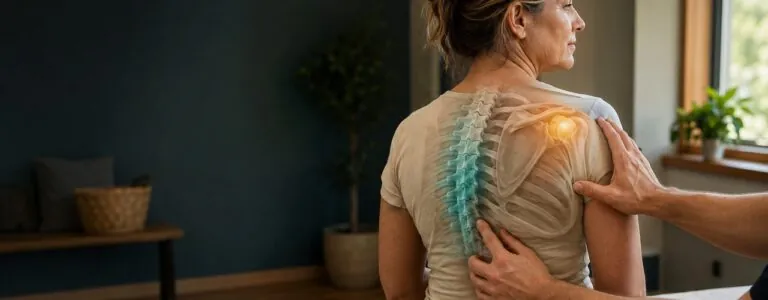
It begins with biomechanics. The body carries its weight in front of the spine, and in women especially the weight of the chest as well. Day after day, year after year, that load pulls everything forward. The body adapts, and the adaptation shows up in the thoracic spine, the mid-back, which slowly rounds. Almost nobody looks there. Nothing hurts yet.
Where it begins
Weight carried in front
The body’s load sits forward of the spine and pulls it forward, every day, for years.
Where the body adapts
Thoracic spine
The mid-back rounds forward, and everything above it inherits the curve.
What follows
Shoulder blade and neck
The blade is not a true joint, so it follows the spine, slides forward and sticks. The neck muscles tighten to hold the head.
Where you feel it
The elbow tendon
The forearm muscles now work off their best length, and every bit of that effort ends at one small attachment.
Think of a guitar string. Tuned to the right tension it plays a clean note. Too loose and there is no note. Too tight and it strains and can snap. Muscles work the same way. Each has a length where it makes its best force. When the shoulder blade is stuck forward and the tissue from the neck and shoulder is tight, the whole line down the arm is pulled off that length, and the forearm has to work harder for the same grip. That is why I call tennis elbow a distal symptom. It shows up at the far end. The problem sits up top.
What you have been told vs. what I actually find
The standard story
- You overused the tendon.
- The problem is the tendon on the outer elbow.
- So treat the elbow: rest, a strap, ice, a shot.
- If it comes back, rest it again.
- If it moves to the other arm, that is a new problem.
What I find
- The arm has been working off its best length for years.
- A rounded upper back and a stuck shoulder blade are pulling on it.
- So examine and treat the whole upper quadrant, then rebuild the tendon.
- The shoulder and neck almost always move less than they should.
- When it moves to the other elbow or the wrist, the cause never left.
Is your elbow connected to your neck and shoulder?
When I examine tennis elbow I examine the tendon, of course. But I also ask whether the upper back can straighten, whether the shoulder blade moves freely on the ribs, whether the neck turns, and whether the shoulder can move without the forearm doing extra work. Very often the shoulder and neck have less motion than the person realizes. Some already have shoulder pain. Some do not have it yet, and in my experience many develop it if nothing changes.
This does not prove the upper quadrant causes every tennis elbow. It tells you the elbow does not work alone. Research has not yet tested my complete explanation or my full treatment method. An untested model is not a disproved model.
Here is what I have seen. In more than thirty years, patients I treated during their first episode of tennis elbow have not come back to me with the same complaint after treatment. That is my clinical observation, and I cannot claim from return visits alone that none of them ever had symptoms again. It is one reason I put so much weight on the first examination.
Before another shot, strap or round of rest
Why treating only the elbow does not last
Rest, a strap, ice or a shot may bring the symptoms down. I am not saying they do nothing. But the upper quadrant is still pulling on the arm the same way it was before.
A Dutch trial in The Lancet showed the same shape. Ninety-two percent of the injection group were better at six weeks, far ahead of physical therapy or waiting. At one year, 69 percent of the injection group counted as a success, against 91 percent of the physical therapy group.
The shot quiets the elbow. It does not change how the arm is being carried and used. Whether to have one is a decision for you and your physician, and you deserve both halves of the story first. Rest has the opposite limit: a tendon needs graded loading to get stronger, and if every painful activity is avoided for good, it never regains the capacity for the work you want back.
And this is the pattern I see again and again. It starts in one elbow. That elbow calms down, and a few months later the other begins. Or the elbow finally gets better and, down the road, the wrist starts to hurt. The problem did not go away. It moved to the next weak spot.
Golfer’s elbow, and the nerve on the inside of the elbow
On the inner side the story is the same. The grip muscles on the inner forearm are working off their best length for the same reason, so we look up the arm first. The tendon is different, so the treatment has to fit what I find rather than copy a tennis elbow plan.
The ulnar nerve passes close to the inner elbow, and this is another place where the pathway matters. Tingling or numbness in the ring and little fingers, especially with weakness, calls for a proper medical assessment. When the nerve is involved, the same questions apply as with the wrist: has anyone looked at the whole pathway from the upper back down?
What about pickleball?
Pickleball injuries seen in US emergency rooms rose from about 1,300 in 2014 to about 24,500 in 2023, mostly in people aged 60 to 79. Many of those are falls, not elbows. But the paddle grip is tight, and many players start in their sixties with an upper back that has been rounding for decades. When a pickleball player comes in with elbow pain I look in the same place I always look. A person should not have to give up an activity they love because the elbow complains. The aim is to make the arm capable of going back to it.
How we treat tennis elbow
At Synergy we call our approach Whole Body Synergy Techniques. For the elbow that means treating the elbow and the whole upper quadrant together. We free the upper back so it can straighten, release the shoulder blade so it moves and settles where it belongs, and ease the tight neck muscles. We use hands-on work, including the John F. Barnes Myofascial Release Approach, so the tissue along the whole arm can return to its working length. Then we strengthen the shoulder blade and the arm and load the elbow tendon back up, slowly and on purpose.
For many people we add deep-tissue laser therapy. I have used therapeutic laser since 1989. The research on laser for tennis elbow is mixed: a 2008 review found short-term pain relief and better grip when the dose was right, and most of those trials used lower-power lasers than ours. I never use it alone, because laser cures nothing by itself. As clinic policy we do not use laser on anyone with a history of cancer.
You can read how we approach shoulder pain, neck pain, frozen shoulder and why headaches can begin in the neck. Different symptom, same region. Your body is not broken. It is adapting.
Patient success stories
“After my time at Synergy, I am back to full functionality with zero pain.”
Patient with elbow and knee pain · Read the story
“I had a case of chronic tendonitis in my left hand and I suffered from severe pain in my right shoulder. As a cashier, my pain was affecting my work. I tried several different techniques as well as pain medication, nothing helped. After coming to S.T.G. for the first time, I had immediate improvements in my pain and the range mobility of my shoulder.”
Linda · Murphysboro, IL
Individual results vary. These are the experiences of specific patients and are not a prediction of your outcome.
Frequently asked questions about tennis and golfer’s elbow
Why won't my tennis elbow heal?
Several things can matter: how the tendon is loaded, how sensitive it has become, and whether other conditions are mixed in. But in my experience the most common reason is that only the elbow is being treated. Tennis elbow is usually the far end of a problem higher up, a rounded upper back, a stuck shoulder blade and tight neck muscles that pull the forearm muscles off their best working length. Rest, a strap or a shot can calm the elbow, but if the upper quadrant does not change, the pain tends to come back, move to the other elbow, or show up in the wrist.
Can I get tennis elbow without playing tennis?
Yes, and most people do. I rarely see a tennis player with tennis elbow. It shows up in gardeners, people who work with hand tools, people who lift heavy pans, people who work at a computer and people who carry children. A large population study linked it to jobs that combine repeated arm movement with force, so repetition and force do matter. In my experience the upper back, shoulder blade and neck are usually part of the story too.
Is my elbow pain connected to my neck or shoulder?
Often, yes. In a 2008 study, 70 percent of people with pain on the outer side of the elbow also had neck or upper back pain, compared with 16 percent of people without elbow pain. When I examine someone with tennis elbow, the shoulder and neck usually move less than they should. A neck or nerve problem can also feel like elbow pain, which is another reason to examine the whole region. Pain that travels down from the neck with numbness or tingling should be checked by your doctor.
Is a cortisone shot a good idea for tennis elbow?
A shot often works fast, and I am not telling you never to have one. But the trials show a price later. In a 2013 trial in JAMA, pain came back in 54 percent of people who had a steroid shot, compared with 12 percent after a placebo shot, and the steroid group did worse at one year. Talk with your physician about the likely benefit and the chance of recurrence, and about how you will rebuild the arm afterward.
Does a tennis elbow strap help?
It can take the edge off for some people while they work, and it is fine to use one. But a 2001 Cochrane review found too little good evidence to say whether braces work, and a strap does not change what is happening in the shoulder blade and neck. Think of it as support while the cause is dealt with, not the fix.
What is the difference between tennis elbow and golfer's elbow?
The side of the elbow. Tennis elbow is on the outer side, where the muscles that lift the wrist attach. Golfer's elbow is on the inner side, where the muscles that bend the wrist and close the grip attach. Neither usually has much to do with the sport it is named after. In my experience both are driven from the same place. Tingling or numbness in the ring and little fingers with inner elbow pain should be checked by your doctor, because the ulnar nerve runs close by.
When to see a doctor first
Please see your doctor first after a fall, a hard knock or a pop, especially with swelling or bruising; if you cannot fully straighten or bend the elbow, or it locks or catches; if it is red, hot and swollen, or with a fever; if you have new hand weakness, lasting numbness or tingling, or pain that travels down from the neck; or if the pain wakes you every night. Call 911 if arm pain comes with chest pressure, shortness of breath, sweating or jaw pain.
If your tennis elbow is not getting better, or it has been “almost better” for months, come and see us. Synergy Therapeutic Group is at 1110 N Cedar Court, Carbondale, IL 62901, and people come to us from all across Southern Illinois. Call (618) 243-7822 and tell us what your arm will not let you do.
If you are ready, you can book your first visit online. And if your pain has lasted a long time, in the arm or anywhere else, our Synergy Healing Program shows you how we work on chronic pain without medication.
Tennis elbow treatment in Carbondale, Illinois
Let us find out why your elbow keeps coming back
A full examination, from the upper back to the elbow, from a physical therapist who has served Southern Illinois since 2004. No referral needed.
References.
Coombes BK et al. Corticosteroid injection, physiotherapy, or both in unilateral lateral epicondylalgia. JAMA 2013. ·
Smidt N et al. Corticosteroid injections, physiotherapy, or a wait-and-see policy for lateral epicondylitis. Lancet 2002. ·
Shiri R et al. Prevalence and determinants of lateral and medial epicondylitis: a population study. Am J Epidemiol 2006. ·
Berglund KM et al. Prevalence of pain and dysfunction in the cervical and thoracic spine in persons with and without lateral elbow pain. Man Ther 2008. ·
Strengthening of rotator cuff and scapular muscles in patients with lateral elbow tendinopathy: a randomized controlled study. 2026. ·
Kraushaar BS, Nirschl RP. Tendinosis of the elbow (tennis elbow). J Bone Joint Surg Am 1999. ·
Bjordal JM et al. Low level laser therapy in lateral elbow tendinopathy: a systematic review and meta-analysis. BMC Musculoskelet Disord 2008. ·
The epidemiology of pickleball injuries presenting to US emergency departments.
Medical disclaimer. This page is for medical information and education only. It is not medical advice, and it does not replace an evaluation by your physician or a licensed physical therapist. Every body is different, so please talk to your healthcare provider about your own situation. If your symptoms are sudden, severe, or getting worse, contact your doctor right away.