
By Chandana Dash, OTR/L · Pediatric Occupational Therapist and co-founder, Synergy Therapeutic Group, Carbondale, Illinois · 30+ years treating children
Clinically reviewed by Chandana Dash, OTR/L on November 19, 2026 · Last updated November 19, 2026
Key Takeaways
- Holiday sensory overload is what happens when noise, crowds, new foods, travel, late nights, and a broken routine all land on a child’s nervous system at the same time. The meltdown at Grandma’s table is usually the last drop in a very full cup, not the start of the problem.
- It is not bad behavior and it is not bad parenting. Your child is not broken. Their nervous system is adapting to far more input than an ordinary day asks of it.
- Sensory overload in children is common, with or without a diagnosis. In one study of 925 school-age children, 16.5 percent of parents, about one in six, said their child reacted strongly to touch or sound.
- The plan has three parts: prepare the week before, take breaks before the crash during the gathering, and protect a quiet recovery day after.
- Your own calm is part of the plan. A child’s nervous system tends to follow the adult closest to them.
- If your child is overwhelmed most days, not only on holidays, that deserves a real conversation with your pediatrician and an occupational therapist.
Let me ask you something. When you picture Thanksgiving this year, what do you feel first? Is it the turkey and the cousins? Or is it a small knot in your stomach, because you already know how the afternoon might end?
If it is the knot, I want you to hear this first. You are not the only one. Many of the parents who sit across from me in November say the same thing: “I love my family. I just dread the holidays.” They say it quietly, almost like a confession, because everyone expects the holidays to be the happy part of the year.
I have been treating children for more than thirty years, and holiday sensory overload is one of the most common things families bring to me this time of year. The families with the calmest holidays are rarely the ones with the “easiest” children. They are the ones with a plan. So let us make one together, from Thanksgiving all the way to Christmas.
What holiday sensory overload really is
In plain words, holiday sensory overload happens when a child’s nervous system takes in more sound, touch, smell, taste, movement, and change than it can sort out in one day. Holidays pile everything on at once.
We have already written about why some children hate tags, loud noises, and certain textures, so I will not repeat all of that here. This post is about the season. Because see, a child who can handle a noisy restaurant on a normal Saturday may not handle it on the fourth busy day in a row.
Here is how I explain it to parents. Think of your child’s nervous system as a cup. Every sensation pours a little water in. The loud cousins pour some in. The itchy holiday sweater pours some in. The strange smell of the kitchen, the late bedtime, the long drive, the stranger who wants a hug. None of those things is too much alone. But the cup does not care which drop came first. It only knows when it is full.
That is why the meltdown so often comes over something tiny. The wrong color cup. The pie that touched the green beans. Everyone at the table sees a child falling apart over pie. What you are really seeing is a cup that was full an hour ago. Your child is not misbehaving. Your child’s nervous system is adapting to a day that asks too much of it.
I think of a little girl who came to me at five years old. She was one of the sweetest children I have ever worked with, as long as things happened a certain way and people kept a certain distance. If someone touched her without warning while she was simply standing there, her whole body went into fright: screaming, scratching, kicking, and then feeling terrible about it afterward. From day one I could see this was not bad behavior. She had real auditory processing difficulty on top of a strong startle response to touch, and proprioception was part of the picture too, so sound and unexpected touch were both hitting her nervous system at once.
Now picture that same child at a holiday gathering. Nobody keeps their distance at a holiday. There is a crowd wherever you turn, everyone is talking loudly, and family members who have not seen her in months want to scoop her up in a hug the moment they walk in. For her, that was a meltdown waiting to happen, and from the outside it looked terrible. Her mother did not know what to do either, because like so many parents, she had been led to believe this was simply behavior.
Once I explained how the auditory, tactile, and proprioceptive pieces were combining in her, and her mother went through our Parent & Caregiver Training Program, it finally started to make sense. She would cover her ears when people spoke to her, and a place like an amusement park was a particular challenge: if fireworks went off without warning, she could not handle it, even though she loved the lights and the beauty of it all. With therapeutic listening and myofascial release over time, and her mother finally understanding what she was seeing, that little girl was able to take in more of the holiday she already loved, at a pace her body could actually handle.
Signs of sensory overload in a child
The meltdown is the last sign, not the first. Watch for the early ones, because that is when a break still works:
- Covering the ears or squinting at the lights
- Getting louder, sillier, or rougher with other children
- Running, crashing, or climbing on furniture
- Hiding under the table or behind your legs
- Chewing on a sleeve, a collar, or a toy
- Pulling at clothes or suddenly refusing food
- Going very quiet, staring, or saying “I want to go home”
Some children get loud. Some children disappear. An overstimulated child is not trying to ruin the day. They are telling you, the only way they can, that the cup is almost full.
Does this only happen to children with autism?
No. Many of the articles you will find about a sensory-friendly Thanksgiving are written only about autism. Autistic children often do find busy holidays very hard, and sensory differences are a big part of autism. But in my experience, children with ADHD, children with anxiety, and many children with no diagnosis at all feel the same overload. The plan below works the same way for all of them, because the nervous system works the same way.
If sensory struggles get in the way every week, not only in November and December, that is a different conversation. Here is how we look at sensory integration difficulties in children.
Why the holidays hit some children so hard
The holidays hit some children hard because every ordinary sensory demand doubles or triples at once, on top of a broken schedule. Think about what a normal Thursday asks of your child. Then think about Thanksgiving. The house is louder. More people want to touch, hug, pinch a cheek. The food is new, mixed, and wet: stuffing, casseroles, gravy on everything. The clothes are stiff and “nice.” Dinner is at two instead of six. Bedtime is gone.
And then there is travel. Two hours in a car seat up I-57, or an airport with its echo and its lines. For a child whose nervous system works hard on an ordinary day, the whole season is like running uphill.
This is hard on parents too, and that is not a coincidence
Holiday sensory overload is not only a child thing. Adults feel it too. I want to say something that almost nobody says out loud. This time of year, the clocks just changed, the weather is turning, the days are shorter and darker. It is supposed to be the happy, jolly part of the year, and for many families it is genuinely one of the most stressful stretches of the whole year. Family gatherings that cannot be skipped are part of it. So is money. The holidays add real financial stress on top of everything else a family is already carrying.
For parents of a child with sensory needs, there is one more layer, and it is a heavy one. If your child struggles at gatherings, you are often quietly carrying guilt, or worry about what other family members are going to think or ask. There is still not enough public awareness of what sensory overload even is, so you do not want to face the questions. And sometimes a close family member decides this is a parenting problem, not a nervous-system problem, and says so. You do not want to answer that either. Layer that on top of everything else the season already asks of you, and of course it feels heavy. It is heavy.
Your nervous system is part of the plan
Here is why your own stress matters so much. Your child does not need words to know how you feel. We wrote about exactly this in The Nervous System Doesn’t Need Words: How a Parent’s Stress Becomes a Child’s Anxiety. Think about driving somewhere and realizing you are lost. That is usually the exact moment the kids in the back seat get the most demanding. In my experience, it is rarely a coincidence: children often feel a parent’s stress before a word is said, and it comes right back at you as bigger behavior.
That is how the vicious cycle starts. The parent is already stressed. The child feels it and gets harder to manage. Now the parent has the holiday stress plus the child’s heightened behavior on top of it, so the parent gets more stressed, and the child feels that too. Round and round. Without a plan, it can feel like everything is spinning out of control, when really it is one nervous system feeding another.
So before you walk up to the door, take one minute in the car. Breathe out slowly, longer than you breathe in. Humming is one way to do this, but it is not the only way, and it is not magic on its own. It is one of several breathing exercises that calm the nervous system, and in my experience the best results come when the whole family practices them together, not just the child. Everyone in the house should be doing some version of this anyway, holiday or not. When the adult settles first, the child usually follows.
The week before: fill the cup less, and fill it slowly
Most of a good holiday is decided before anyone arrives. Start about a week ahead.
Show them the day before it happens. Show photos of who will be there. Tell the day like a story: we drive, we say hello, we eat, you can rest in the back room, we come home. Children who know what is coming spend less energy bracing for it.
Pick the clothes together. The soft outfit your child already wears is the right holiday outfit. If a family photo needs the nice shirt, put it on for the photo and take it off after.
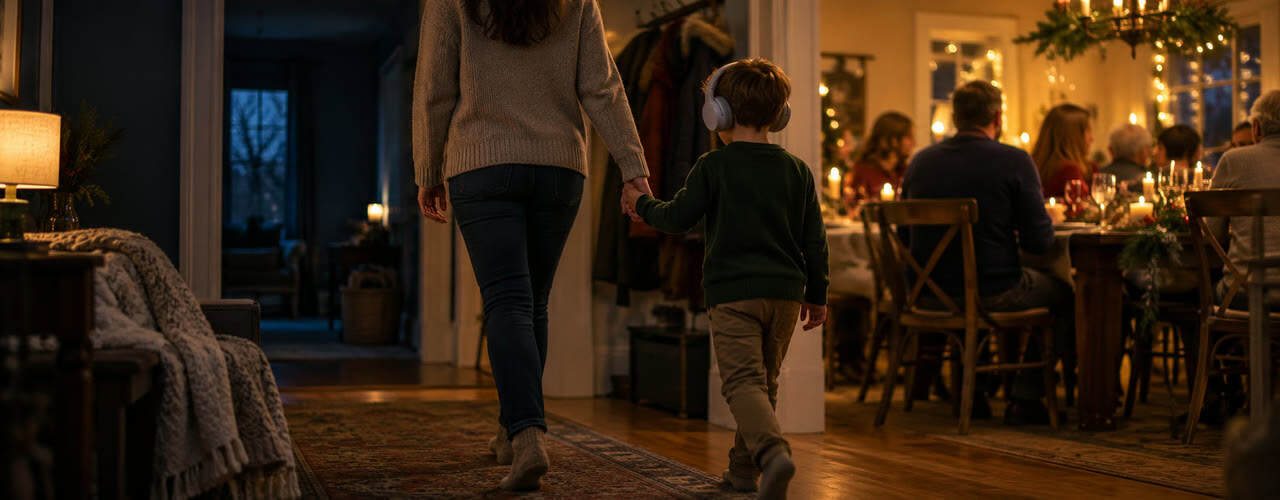
Pack a small calm-down bag. Headphones your child has already practiced with at home, a favorite toy, something to chew or squeeze, a soft blanket, and two or three safe foods. Familiar beats new.
Protect sleep like it matters, because it does. The American Academy of Sleep Medicine recommends 10 to 13 hours in 24 hours for children ages 3 to 5, and 9 to 12 hours for ages 6 to 12. A tired nervous system has a much smaller cup. Keep bedtime as close to normal as you can, even at someone else’s house.
Ask for a quiet room ahead of time. A short message to the host is enough: “We’re so excited to come. Our daughter does best with a quiet spot to take breaks. Could we use the back bedroom for a few minutes at a time? We’ll bring a few of her own foods too. Thank you for making room for her.” That one message can save the whole afternoon. If you are the one hosting, pick that room in your own house now.
During the gathering: breaks before the crash, not after
Here is the most important idea in this whole post. Take the break before your child needs it, not when they fall apart. By the time a child is screaming under the table, the cup spilled a while ago.
Give heavy work before you walk in. Let your child carry the pie, push the cooler, or do a few wall push-ups in the driveway. Many children find this deep pressure through the muscles and joints calming. Watch how your child responds. If it settles them, keep it. If it winds them up, drop it.
Arrive early, and plan breaks before your child reaches the edge. A quiet house that slowly fills up is easier than a room that is already roaring. Some children need a walk outside or ten quiet minutes in the back room sooner than others. Watch the early signs more than the clock. Make the break part of the plan, not a punishment or a last-minute rescue.
Let your child say hello their way. A wave, a high five, or a “hi” from behind your leg is a real greeting. A forced hug on a stressed system is one more drop in a full cup.
If a meltdown still comes, and some days it will, stay close, lower your voice, use fewer words, and move to quiet. This is not the moment to teach or to explain. It helps to know the difference between a sensory meltdown and a tantrum, because they need very different responses.
Plan your exit before you arrive. Decide the leaving time in the car, not at the table. Leaving at 3 p.m. while everyone is still smiling is a good holiday. It is not a failure.
The picky eater at the Thanksgiving table
Parents ask me every November: should I make my child try the turkey? My answer is no. Not at the holiday table. A plate full of new textures, in a loud room, with ten adults watching, is the hardest possible place to learn a new food.
Put the safe foods on the plate. If your child wants to touch or smell something new, wonderful. If they don’t, that is fine too. Food work happens on quiet days at home, one texture at a time, with no pressure.
And it does grow over time with the right help. Lydia came to us at 10 months old with a severe aversion to any food or drink. Her mother, Moriah, later wrote that after almost a year of therapy Lydia “is now tolerant of and enjoys many sensory experiences she had previously resisted.” That did not happen at a holiday dinner. It happened slowly, week by week, at a pace Lydia could handle.
When relatives don’t understand: what to say
You don’t need to win a conversation about your child’s needs. You only need one calm, kind sentence, and then you move on. This part can hurt the most, and someone at that table probably will say something about your child.
In my experience, a grandparent or another family member who questions what you are doing usually is not being unkind. They just do not understand the situation yet, and it is genuinely not as simple as it looks from the outside. Once they understand what we have seen work, they almost always become more empathetic. That is exactly why we welcome grandparents and other family members into sessions at Synergy: so they can watch, ask questions, and get that same inside view a parent gets. It is also why we built our Parent & Caregiver Training Program for the whole family, not only parents. A grandparent who has sat through even one session tends to stop asking your child to just try harder.
When someone says “She just needs more discipline,” try: “Her body gets overwhelmed by noise, so we take breaks. It helps her enjoy the day with us.”
When someone says “Just one bite,” try: “We’re working on new foods at home. Today he’s eating what he’s comfortable with.”
When someone says “Come give Grandma a hug,” try: “He’s going to give you a high five today.”
You are not asking permission. You are explaining your child. That is why I say parents are the most powerful people in this work.
From Black Friday to Christmas: same cup, same plan
From Black Friday to New Year’s, the whole world gets louder. Christmas brings its own kind of noise: blinking lights, the Christmas program at church or school, a long line to see Santa, and a pile of presents opened in one loud hour.
If you can, skip the busiest store trips or go early in the morning. If your child must come, give them a job, like pushing the cart. Set the Christmas lights at home to steady instead of flashing. Sit at the end of a row near the door at a program, so a break is easy. Open gifts one at a time, with a pause in between. The Santa photo is optional. On long drives, stop before your child asks, and let them get out and move.
Carbondale has its own version of this test every year: the Lights Fantastic Parade, downtown on Illinois Avenue the first Saturday of December, in the evening dark with crowds, lights, and loud music. It is a wonderful night, and it is also exactly the kind of event that fills a sensory cup fast. If you go, treat it like Thanksgiving: pick a spot near the edge of the crowd, not the middle, bring the headphones, and plan to leave whenever your child is done, even if that is ten minutes in.
The day after: plan for the crash
Many parents tell me the same story. “He held it together all day, and then on Friday he fell apart over nothing.” That is not a new problem. That is the bill for Thursday.
Children often hold on in public and let go at home, where they feel safe. So plan Friday as a recovery day. Pajamas, familiar food, outdoor play, early bedtime. No big trips. Holiday meltdowns the next day are not a sign that the plan failed. They are a sign your child worked very hard.
That night, write down what worked and what didn’t: which break helped, which room was too loud. That note is your plan for Christmas.
When it is more than a hard holiday
A tough Thanksgiving is common. But please talk to your pediatrician if your child is overwhelmed most days, not only on busy ones; if a skill they had is now lost; if sleep or eating has changed a lot; or if sensitivity to sound is new, one-sided, or comes with ear pain. Those need a doctor’s eyes first.
If daily life at home keeps running into the same wall, our pediatric occupational therapy team can help. We look at how your child takes in the world, find the level their system can handle today, and build from there. And we teach you, because you are the one there at the dinner table.
One thing to do today
It makes me emotional when parents tell me they stopped going to family events because of how they always end. It does not have to go that way. Tonight, sit down with your child and look at photos of the people you will see on Thanksgiving. Just that. Tell them who each person is and one nice thing about them. It is a small thing. But it is a drop of calm in the cup before the day even starts.
If you want to talk it through, call our pediatric team at Synergy Therapeutic Group, 1110 N Cedar Court, Carbondale, IL 62901, at (618) 243-7822. Families come to us from all across Southern Illinois. Tell us about your holidays, your mornings, and your dinner table. That first call is just us listening.
If you are ready to come in, you can book your child’s first visit online. And if you want to start at home, our Parent & Caregiver Training Program teaches you, step by step, what we teach families in the clinic. You know your child better than anyone. You just need the plan.
Frequently asked questions
Is it okay to leave Thanksgiving dinner early because of my child?
Yes. Leaving while your child is still calm is a good plan, not a failure. Decide the leaving time before you arrive, tell the host ahead of time, and say goodbye while everyone is still smiling. A short, happy visit teaches your child that family gatherings can feel safe. A long visit that ends in a meltdown teaches the opposite.
My child is a picky eater. Do I have to make them try the turkey?
No. The holiday table is the hardest place to try a new food: it is loud, the textures are mixed, and many adults are watching. Bring your child’s safe foods and let them eat those. If they want to touch or smell something new, that is a win. Work on new foods at home on quiet days, one texture at a time, with no pressure.
How do I explain my child’s sensory needs to grandparents?
Keep it short and calm. Try something like: “Her body gets overwhelmed by noise and crowds, so we take breaks. It helps her enjoy the day with us.” Tell them before the day if you can, not at the table. Most grandparents want to help. They just need to know what helps.
Why does my child fall apart the day after a holiday, not during it?
Many children hold themselves together in public and let go at home, where they feel safe. The day after a holiday, the nervous system is tired from all the noise, people, new food, and late nights. Plan that day as a quiet recovery day with familiar food, outdoor play, and an early bedtime.
Is holiday sensory overload a sign of autism?
Not by itself. Many children feel overwhelmed at busy family gatherings, including children with autism, ADHD, or anxiety, and many with no diagnosis at all. One hard holiday does not tell you what is going on. If your child struggles with sounds, clothes, or food most weeks, or you have concerns about speech, play, or social skills, talk to your pediatrician and ask about an occupational therapy evaluation.
Should we just skip family gatherings until my child is older?
No. Children need experience with family gatherings and other busy parts of life to learn how to take part in them. If we keep a one- or two-year-old away from every noisy celebration, simply waiting until they are older does not teach their nervous system what to do with the noise, lights, and crowds. Think of the Fourth of July: if a child has never had a chance to experience a celebration in a manageable way, the fireworks do not become easier just because another birthday has passed. Start with what your child can handle: perhaps a short visit, a spot away from the crowd, hearing protection around loud events, familiar foods, breaks, and a planned exit. Then build on what went well the next time. I am not asking you to make your child sit through something that overwhelms them. I am asking you to give them a real chance to take part, at a level their body can handle, and let that grow a little at a time. If every attempt ends in significant distress, or your child is overwhelmed most days, talk with your pediatrician and an occupational therapist about how to move forward.
Written by Chandana Dash, OTR/L, co-founder of Synergy Therapeutic Group in Carbondale, Illinois, and a pediatric occupational therapist with over 30 years of experience helping children with sensory processing difficulties and the families who love them across Southern Illinois. Clinically reviewed by Chandana Dash, OTR/L on November 19, 2026 · Last updated November 19, 2026.
This page is for medical information and education only. It is not medical advice, and it does not replace an evaluation by your child’s physician or a licensed occupational therapist. Every child is different, so please talk to your healthcare provider about your own situation and your child. If you have a concern about your child’s hearing, sleep, growth, development, or a skill they have lost, contact your pediatrician.
Sources: Ben-Sasson A, Carter AS, Briggs-Gowan MJ. Sensory over-responsivity in elementary school: prevalence and social-emotional correlates. Journal of Abnormal Child Psychology. 2009;37(5):705-716. doi:10.1007/s10802-008-9295-8. · Paruthi S, Brooks LJ, D’Ambrosio C, et al. Recommended amount of sleep for pediatric populations: a consensus statement of the American Academy of Sleep Medicine. Journal of Clinical Sleep Medicine. 2016;12(6):785-786. doi:10.5664/jcsm.5866. · American Academy of Pediatrics, HealthyChildren.org. Healthy Sleep Habits: How Many Hours Does Your Child Need?
See more of our articles in Google
If this was worth your time, you can tell Google you want to hear from us. It takes one tap, and it makes our articles more likely to turn up the next time you search for answers about pain, movement, or your child’s development.
