
Key Takeaways
- Chronic pain can far outlast the injury that caused it, because it rewires the nervous system to stay switched on long after the tissue heals.
- A heightened system changes the whole body — heart rate, blood pressure, sleep, mood, even how ordinary movement feels — not just the sore spot.
- Years of pain strengthen and speed up the nervous system’s pain pathways (maladaptive neuroplasticity); the fascia, the connective tissue linking the whole body, is part of the picture too.
- The CDC estimates more than 1 in 5 U.S. adults live with chronic pain — so if this is you, you are far from alone.
- The same plasticity that turned the volume up can turn it back down. Your body is not broken; it is adapting — and it can be guided back.
Part 2 of The Nervous System Series. Previous: Part 1 — Why Your Brain Decides What Hurts. Next: Part 3 — The Nervous System Doesn’t Need Words.
Hi, it’s Subrat. So if your injury has healed but you are still hurting, understanding how chronic pain rewires the nervous system is the piece almost nobody explains — and it is the piece that finally makes your pain make sense.
Here is the short answer: chronic pain rewires the nervous system by keeping it on high alert. After months or years, the pathways that carry pain grow faster and more sensitive, so the brain keeps producing pain from signals that should be harmless — even after the original injury has healed. The hopeful part is that this wiring can be trained back down.
In Part 1, I told you that your brain decides what hurts — that pain is your brain’s interpretation of the signals, not a wire running straight from the injury. So now I want to answer the very next question, the one I hear in my clinic almost every week: if my injury has healed, why am I still in pain?
Why Am I Still in Pain After the Injury Has Healed?
So when pain has been with you for one, two, five, even ten years, something has changed. You are far from alone in this — the CDC estimates that more than 1 in 5 U.S. adults live with chronic pain. Imagine the original injury as a house fire. The fire is out. But years later, the smoke alarm is still screaming. The injury may be long gone, but the nervous system has stayed switched on — and in a nervous system that is turned all the way up, the brain keeps perceiving danger, so it keeps producing pain.
So why does the alarm stay on? Sometimes it begins with a serious injury. Sometimes months of guarding a painful area. Sometimes surgery. Sometimes years of physical or emotional stress. Whatever started it, the nervous system learned that the world was dangerous — and it forgot how to turn the alarm back off. That is the root of so much persistent pain.
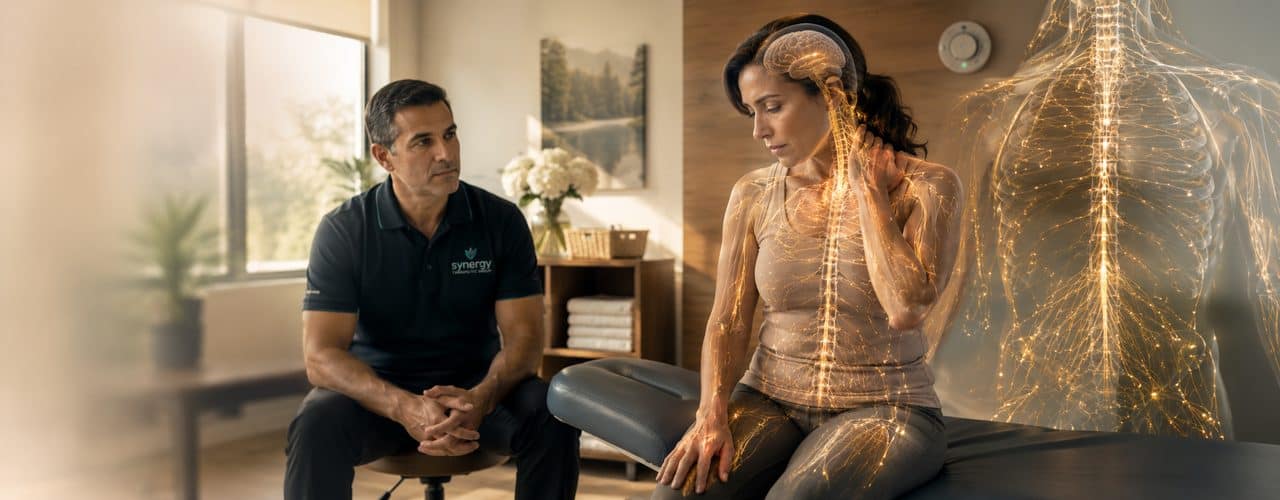
Here is the part most people miss: it is not just one sensation in one spot. When the whole system is heightened, everything shifts with it. Heart rate. Blood pressure. How reactive you are. How you sleep. How you handle a stressful day. The volume knob did not just turn up for your back or your neck — it turned up for the whole body.
And it changes how ordinary movement feels. Over time, even normal walking, bending, reaching, or lifting can begin to feel threatening — not because those movements are damaging, but because the nervous system has learned to expect danger whenever they happen.
The Patients Who Cannot Be Touched
So let me tell you about something I have seen many times, because it shows you how far this can go. I have worked with people who cannot be hugged. The pain is so amplified that even a light touch is too much. You could blow gently near their ear and they would cry out. Now — a puff of air is not damaging anyone’s ear. There is no injury there. But their nervous system has learned to read almost any input as a threat, and it answers the only way it knows how: with pain.
That is central sensitization taken to its extreme — when the nervous system becomes so sensitized that it amplifies ordinary, harmless input into real pain. And it tells you the real truth about chronic pain.
The problem is not how much damage there is. The problem is how loudly the system is responding.
What Is Actually Happening Inside the Nervous System?
So what is actually going on under the surface? A few things, really, and they build on each other.
First, the nervous system rewires. After years of pain, the nervous system strengthens existing pathways and forms new patterns of communication — the pain signal has traveled the same roads so many times that they get wider and faster. Pain neuroscience describes this as maladaptive neuroplasticity and central nervous system hyperexcitability: the system literally becomes better at producing pain. So you end up feeling something as painful that was never supposed to hurt at all. Every repetition strengthens the pathway — not because your body is getting weaker, but because your nervous system is getting better at protecting you.
Second, this is not only a nerve story — it reaches into the connective tissue, the fascia. Fascia is a continuous network of connective tissue that links muscles, joints, nerves, and organs throughout the body. Changes in its mobility, tension, and sensory input can influence how the nervous system experiences movement and pain. We’ll come back to fascia later in this series, because it is one part of a larger nervous-system story that helps explain why stress and regulation can ripple through an entire family.
Third, there is an inflammatory piece. In long-standing pain, low-grade neuroinflammation can reach areas of the brain involved in emotion, attention, and decision-making — which may be part of why chronic pain so often comes bundled with low mood, poor sleep, and brain fog. That is not a separate problem you developed. It is the same heightened system showing up in another form.
Why This Matters — and Why It Is Hopeful
So I know that can sound heavy. Let me flip it over, because the same fact that traps people is the fact that frees them. If the nervous system learned to be this sensitive, then the nervous system can learn the other direction too. Neuroplasticity is not a one-way street. The road that got wider can get quieter again. Brains change every day. The question isn’t whether your nervous system can change — it is what you are teaching it every day. Your body is not broken. It is adapting — and it adapted itself into this pattern, which means it can be guided back out of it.
But that takes the right approach. You cannot chase the pain around from spot to spot. You have to work with the whole system — the tissue, the fascia, and the nervous system that is running the show. That whole-person rehabilitation — calming and retraining the system, the heart of nervous system regulation — is the depth chronic pain recovery actually requires, and it is how we work on our chronic pain page here in Carbondale, IL.
So, How Chronic Pain Rewires the Nervous System
By keeping the alarm switched on. Years of pain make the nervous system more sensitive and its pain pathways faster, so it produces pain from signals that should be harmless — even after the tissue has healed. So let me sum this up for you.
Number one: chronic pain can far outlast the injury that started it, because the nervous system stays switched on long after the tissue heals.
Number two: a heightened system changes the whole body — not just one spot — which is why light touch, and even ordinary movement, can hurt, and why sleep and mood get pulled in.
Number three: the same plasticity that turned the volume up can turn it back down, with the right treatment.
If you’ve spent years treating the painful body part without anyone explaining the nervous system behind it, maybe it’s time for a different conversation.
Ready to understand what is really going on?
At Synergy Therapeutic Group in Carbondale, IL, I provide one-on-one chronic pain treatment for adults across Southern Illinois whose pain has outlasted every explanation — helping you find the real driver and calm an over-protective nervous system.
Related reading: next in this series, The Nervous System Doesn’t Need Words: How a Parent’s Stress Becomes a Child’s Anxiety.
Frequently Asked Questions
Why do I still have pain if my injury has healed?
Because the pain is being driven by a heightened nervous system, not by the original tissue damage. After years of pain the system stays switched on and keeps producing the signal, even once the injury is gone.
What is central sensitization?
It is when the nervous system becomes more sensitive over time and amplifies signals that should not hurt. It is why some people in long-term pain react to light touch or gentle pressure with real pain.
Why do pain medications sometimes stop working?
Because medication may reduce the signal temporarily, but it doesn’t necessarily change the nervous system that is amplifying the signal. Long-term improvement often requires calming the nervous system itself.
Can a rewired nervous system really change back?
Yes. The same neuroplasticity that made the system more sensitive can work in reverse. With the right, whole-system approach, the nervous system can be guided to turn the volume back down.
Do you treat chronic pain near Carbondale?
Yes. At Synergy Therapeutic Group in Carbondale, IL, we work with adults throughout Southern Illinois whose pain has lasted far longer than it should have.
Subrat Bahinipati, PT, is a physical therapist with more than 30 years of experience specializing in chronic pain and integrative healing, and co-founder of Synergy Therapeutic Group, 1110 N Cedar Court, Carbondale, IL. This article is educational and is not a substitute for individual medical care.
See more of our articles in Google
If this was worth your time, you can tell Google you want to hear from us. It takes one tap, and it makes our articles more likely to turn up the next time you search for answers about pain, movement, or your child’s development.