

Key Takeaways
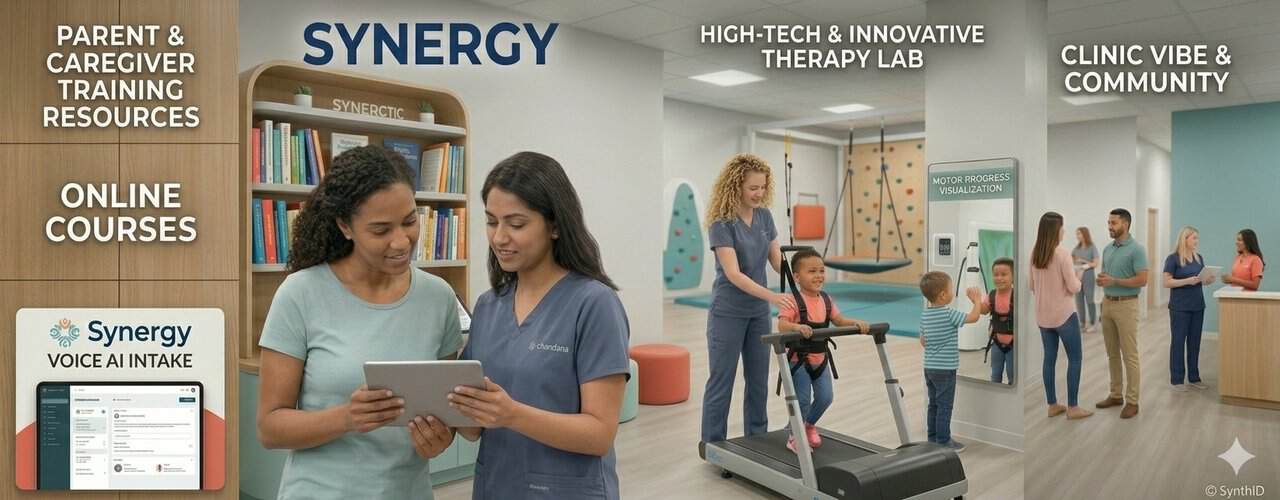
- Pediatric care here is a system, not a single service. This page maps what we offer and the conditions we treat.
- Some families arrive with a diagnosis and some arrive with only a worry. Both are welcome.
- Our resources are built for parents to use at home, because that is where most of the progress happens.
- If you are not sure where to start, start with a conversation.
Reviewed by Chandana Dash, OTR/L — Co-founder, Synergy Therapeutic Group
Pediatric care at Synergy is a system, not a single service. This page is a map of what we offer, the conditions we treat, and the resources we have built for families.
Some families come to us with a diagnosis in hand and a clear plan they need help executing. Others come with a worry they can’t quite name — something is off, the pediatrician said wait, the school suggested an evaluation but never followed up. Both kinds of family belong here. Our pediatric program is designed to meet you wherever you are in the process and give you a clear next step.
The pediatric specialty at Synergy
Pediatric occupational therapy is the heart of what we do for children. It is play-based, child-led, and family-centered — not a series of drills at a desk. We work with the underlying systems that drive everything else: sensory processing, motor coordination, regulation, attention, communication, and the foundational skills children need to thrive at home, at school, and in the community.
What makes our approach different is the family piece. We do not treat the child in isolation and send them home unchanged. We coach you — the parent — on what is happening in your child’s body and what you can do every day to support their growth. Education is part of the therapy here, not an afterthought.
Conditions we treat
We work with children across a wide range of presentations — with or without a formal diagnosis. The conditions below link to detailed pages explaining each one and how we approach it:
- Sensory processing disorder — the nervous system’s difficulty organizing input from the senses
- Autism spectrum — supporting children across the spectrum with family-centered care
- Developmental delays — when milestones aren’t unfolding on schedule
- ADD and ADHD — attention and self-regulation work
- Handwriting problems — fine motor and visual-motor integration
- Fine motor delays — pincer grasp, scissor skills, self-care
- Motor planning challenges — body awareness and coordination
- Dyspraxia — difficulty learning new motor sequences
- Cerebral palsy — motor support across childhood
- Perceptual difficulties — visual processing and spatial awareness
- Learning disabilities — supporting the foundations that learning depends on
- Other neurological conditions from birth
- Return to sports — pediatric recovery after injury
The Parent & Caregiver Training Program
Beyond one-on-one therapy, we have built a structured program that gives parents and caregivers the foundational tools to support a child with sensory, developmental, or behavioral challenges at home, every day. The program is delivered online so families across the country and internationally can participate.
Learn more about the Parent & Caregiver Training Program →
Telehealth — care beyond Carbondale
For families outside Southern Illinois — or families whose children find clinic visits overwhelming — we offer pediatric occupational therapy via telehealth. For many families, telehealth coaching in the home environment turns out to be more effective than clinic-only sessions, because the child’s nervous system is regulated by familiar surroundings and the parent learns to provide the right input in the moments that actually matter.
We work with telehealth families nationally and internationally.
What to do if you are not sure where to start
If you do not know which page above describes your situation, that is okay. Many families do not. The starting point is the same regardless: an evaluation. We look at how your child moves, plays, regulates, and connects, listen to what you have been noticing, and tell you what we see. From there, the right path forward becomes clear.
Recommended Reading
Deepen your understanding with these related articles from our health blog:
Frequently asked questions
Do I need a referral from my pediatrician to start?
No. Illinois allows direct access to occupational therapy, so you can book an evaluation with us directly. If your insurance requires a referral for coverage, we will help you sort that out — but you do not need one to be seen.
What happens at the first pediatric OT evaluation?
The first visit is mostly information gathering. We talk with you about what you have been noticing, take a developmental history, and observe your child through play and structured tasks. We look at sensory processing, motor coordination, regulation, communication, and daily living skills. By the end, we give you a clear picture of what we see and a recommended plan.
Can I be in the room with my child during therapy sessions?
Yes — for pediatric OT, parent involvement is part of the work. The family-centered approach means we coach you alongside your child, not separate from them. There are stages where a child may benefit from working with the therapist alone, but that is a choice we make together, not a default.
How long are pediatric OT sessions and how often does my child come?
Sessions are typically 45 to 60 minutes. Frequency depends on the goals — many children come once a week, some twice a week during intensive periods, others less often once foundational work is established. We give you a specific recommendation at the evaluation.
Can I use HSA or FSA funds for pediatric occupational therapy?
Yes, in most cases. Pediatric OT is a qualified medical expense under standard HSA and FSA plans. We can provide the documentation your plan needs for reimbursement.
This page was reviewed by Chandana Dash, OTR/L, who has practiced pediatric occupational therapy for more than 32 years. She specializes in family-centered care for children with sensory, developmental, motor, and neurodevelopmental challenges. She is the co-founder of Synergy Therapeutic Group in Carbondale, Illinois.
This page is for general education, not medical advice. Everyone’s body and history are different — for guidance on your specific situation, talk with a licensed physical or occupational therapist. Synergy Therapeutic Group · 1110 N Cedar Court, Carbondale, IL 62901 · (618) 243-7822.