

Key Takeaways
- Migraine falls far harder on women: three to four times more likely than men, and more than 4 in 10 women over a lifetime.
- For most headache patients I see, the source is mechanical: the neck, upper back, jaw, or the small muscles at the base of the skull.
- Pain behind the eyes is one of the most common referral patterns from the upper neck.
- If medication is the only thing that helps and nothing has been examined mechanically, the cause has not been found yet.
Medically reviewed by Subrat Bahinipati, PT, DPT — Co-founder, Synergy Therapeutic Group
Headaches and migraines are neurological conditions producing pain in the head, ranging from tension-type tightness to debilitating migraine attacks with sensitivity to light, sound, and nausea.
Migraine affects about 12% of Americans in any given year — but it falls far harder on women. After puberty, women are three to four times more likely to have migraine than men, and more than 4 in 10 women will have it at some point in life. In 34 years, nearly every headache patient referred to me has been a woman — and on the rare occasion a man is sent to me for headaches, there’s usually something else driving it. Tension-type headaches, by contrast, affect up to 78% of adults at some point and fall more evenly across men and women. The most common signs are head pain that may pulse or ache, sensitivity to light or sound, nausea, neck tightness, visual disturbances (aura), and triggers that include stress, posture, or hormonal changes.
Unlike conventional approaches that focus only on medication, Synergy Therapeutic Group treats headaches and migraines by addressing the structural drivers — cervical spine mobility, suboccipital tension, jaw mechanics, and nervous-system regulation — that medication alone cannot reach.
Most headaches are not migraines. They are musculoskeletal — and the source is almost always something physical therapy can address.
If you have headaches several times a week, several times a month, or any pattern that interferes with your life — you are not alone, and the standard medical pathway is not the only option. Medication can manage symptoms. It rarely addresses what is causing the headache in the first place. For the majority of headache patients we see, the source is mechanical: tension in the neck, upper back, jaw, or the small suboccipital muscles at the base of the skull. When that mechanical source is treated, the headaches stop coming back.
The two big surprises about headaches
Surprise #1: Most headaches are not migraines. Research suggests only a small percentage of headaches that get diagnosed as migraine are actually true migraine — a specific neurological event with a defined pattern of aura, severity, and triggers. Many “migraines” turn out to be musculoskeletal headaches that respond to physical therapy in a way migraine medication never could.
Surprise #2: Most headaches start somewhere other than the head. The pain you feel in your forehead, temples, behind the eyes, or at the top of your skull is often referred pain — the actual source is in the neck, upper back, shoulders, or jaw. The head is where the body is delivering the signal. The neck is where the problem is hiding.
Common headache patterns we treat
- Cervicogenic headaches — pain referred from the cervical spine. Often felt above one eye, in one temple, or at the base of the skull. Triggered by neck movement or sustained posture.
- Tension-type headaches — band-like pressure around the head, often from upper-back and shoulder tension. The most common headache pattern.
- TMJ-related headaches — jaw clenching and jaw joint dysfunction often refer pain into the temples and behind the eyes.
- Vestibular migraine / dizziness-related headache — when balance system dysfunction overlaps with headache. Treatable.
- Post-concussion headaches — common after head injury; respond to combined vestibular and musculoskeletal work.
- Hormonal-pattern headaches — particularly common in women. Often have an additional musculoskeletal component that responds to PT.
- Post-trauma headaches — after whiplash, falls, or surgery. Often persistent until the underlying mechanical pattern is addressed.
How we treat headaches at Synergy
An evaluation looks at where your pain is, when it started, what triggers it, what relieves it. Then we look at the body: cervical spine mobility, upper back posture, jaw mechanics, shoulder and trapezius muscle tension, breath pattern, sleep position, and the small muscles at the base of the skull where many headaches originate.
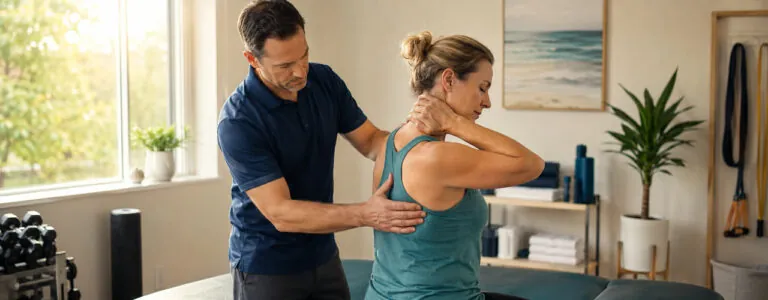
Treatment is hands-on. We use myofascial release, manual therapy of the cervical and thoracic spine, dry needling for trigger points in the upper back and neck, and intra-oral work for jaw-related patterns. We also work on the long-term factors — posture, breathing, screen ergonomics, sleep position — that keep headaches alive between treatment sessions.
Patients consistently report that headaches become less frequent, less severe, and shorter-lasting within the first few visits. For many, they stop returning altogether once the underlying mechanical pattern is unwound.
A patient’s story
Here is one patient’s headache story — the path from chronic headaches to lasting relief. It is a good example of what is possible when the underlying mechanical pattern is finally addressed:
The headache–neck–jaw triangle
Headaches rarely show up alone. The cervical spine, the temporomandibular joint (jaw), and the upper back form a connected system, and dysfunction in one almost always pulls on the others. Patients with chronic headaches typically have neck pain, jaw clicking or clenching, or upper back tension as silent companions. Treating just the headache without addressing the rest gives partial results. Treating the whole triangle gives lasting change.
Related conditions we treat
- Chronic neck pain — the most common source of headaches
- TMJ pain — frequently linked to headaches
- Vertigo and dizziness — often coexists with headache
- Shoulder pain — upper back and shoulder tension drives headaches
- Chronic pain — headaches are often part of a broader chronic pain picture
Recommended Reading
Deepen your understanding with these related articles from our health blog:
Frequently asked questions
Are tension headaches and migraines the same condition?
No. Tension-type headaches typically feel like a pressure or band around the head and are driven largely by muscular and postural patterns. Migraines are a specific neurological event involving a defined progression of symptoms, often one-sided, often with sensitivity to light or sound. Many patients have features of both, and many “migraines” turn out to be tension or cervicogenic headaches that respond to physical therapy.
What is a cervicogenic headache?
A cervicogenic headache is a headache whose source is the neck — typically the upper cervical spine and the suboccipital muscles. The pain refers up into the head, often above one eye or at the base of the skull. Imaging usually looks normal because the source is muscular and joint-related, not structural pathology.
Can my pillow position cause morning headaches?
Yes. A pillow that holds the neck in poor alignment overnight can sustain tension in the suboccipital muscles and upper cervical spine, leading to headaches that are worst on waking and improve through the day. We evaluate sleep posture as part of headache assessment.
Why do I get headaches behind my eyes?
Pain behind the eyes is one of the most common referral patterns from the upper cervical spine and the suboccipital muscles. Patients often assume the eyes themselves are the problem and have unremarkable eye exams. The fix is usually upstream — neck and shoulder work.
When should I see a doctor about my headaches?
See a physician promptly if you experience a sudden severe headache, headache with neurological symptoms (vision changes, weakness, slurred speech), headache after head trauma, or a new headache pattern in someone over 50. For chronic recurrent headaches without those red flags, an evaluation here is a reasonable starting point.
This page was medically reviewed by Subrat Bahinipati, PT, DPT, who has practiced physical therapy for more than 32 years and specializes in chronic and complex musculoskeletal conditions. He is the co-founder of Synergy Therapeutic Group in Carbondale, Illinois.
What is the difference between cervicogenic headache and migraine?
Cervicogenic headaches start in the neck or base of skull and usually affect ONE side. They are triggered by neck movement or position. Migraines involve throbbing, light/sound sensitivity, nausea, and visual aura. The two can coexist. Cervicogenic headaches respond very well to physical therapy because the source IS the neck — migraines need a multi-pronged approach.
Can physical therapy stop migraines?
It can reduce frequency and intensity, even if not eliminate them entirely. Many migraine sufferers have neck dysfunction that is a trigger — addressing it with manual therapy, posture work, and nervous system regulation often cuts migraine days significantly. We work alongside your neurologist or primary care, not instead of medication when you need it.
Why do I get headaches at the base of my skull?
Pain at the base of the skull is the classic sign of cervicogenic headache or suboccipital muscle tension. The tiny muscles connecting the top of your spine to your skull (suboccipitals) hold tremendous tension from forward head posture, stress, and screen time. Manual release of these muscles often relieves headaches that medications have not touched.
This page is for general education, not medical advice. Everyone’s body and history are different — for guidance on your specific situation, talk with a licensed physical or occupational therapist. Synergy Therapeutic Group · 1110 N Cedar Court, Carbondale, IL 62901 · (618) 243-7822.