

Key Takeaways
- Motor planning, or praxis, is the ability to figure out and then carry out a new physical action.
- Difficulty with motor planning affects an estimated 5-6% of children, and it is what dyspraxia describes.
- A child may handle familiar routines well and struggle badly with anything new or multi-step.
- Breaking tasks into steps and practicing them in order is the core of how we help.
Reviewed by Chandana Dash, OTR/L — Co-founder, Synergy Therapeutic Group
Motor planning (praxis) is the ability to conceive, plan, and execute new or unfamiliar physical actions — and difficulty with motor planning is called dyspraxia.
It affects an estimated 5-6% of children, often with overlap to ADHD, autism, sensory processing differences, and coordination disorders. The most common signs are clumsiness, difficulty learning new motor skills (riding a bike, tying shoes), trouble with multi-step tasks, slow physical learning compared to peers, and avoidance of new physical activities.
Unlike conventional approaches that focus only on repetitive practice, Synergy Therapeutic Group treats motor planning challenges by building the underlying sensory foundation, breaking new skills into achievable steps, and helping the child experience competence — which is what motor learning actually requires.
Your child is not clumsy or lazy. The brain is working hard to plan movements that come naturally to other kids — and it needs the right kind of practice.
Motor planning is the brain’s ability to figure out, sequence, and execute a new movement. When motor planning is strong, a child watches another kid skip and skips a few minutes later. When motor planning lags, the same child watches, tries, falls, tries again, gets frustrated, and stops trying. The body did not refuse. The internal blueprint was harder to assemble.
What motor planning actually is
Therapists call this skill praxis — the three-step process of (1) coming up with an idea for a movement, (2) planning how to do it, and (3) executing it smoothly. Each step relies on different brain systems. A child can be strong in one step and weak in another. Some kids have great ideas for movements but freeze when it comes time to do them. Others can copy a movement perfectly but cannot generate one on their own. Identifying where the breakdown is — is what makes therapy targeted.
What it looks like in everyday life
Children with motor planning challenges often look like they are uncoordinated, distractible, or hesitant. They may avoid the playground equipment other kids gravitate toward. They take longer than peers to learn new physical skills — riding a bike, tying shoes, using utensils, jumping rope. They appear clumsy: bumping into things, knocking over cups, mis-judging where their body is. They may resist new physical situations they have never encountered before. Some children have meltdowns at PE or birthday parties — environments that demand constant new movement decisions.
Motor planning difficulty does not mean a child lacks intelligence. It means they have to think harder than other kids about movements that should be automatic.
How we approach motor planning at Synergy
Therapy for motor planning is a sequence — not random movement practice. We start by identifying where the breakdown lives: idea, plan, or execution. We build the missing piece through deliberately designed play challenges that target it. We layer in success at each stage so the child builds confidence alongside skill.
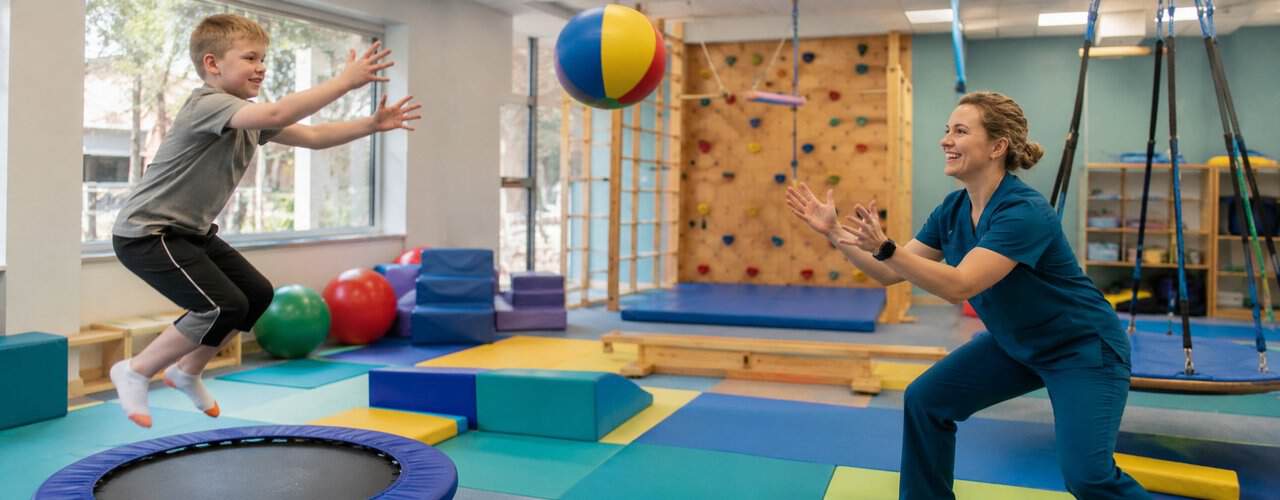
Sessions often include obstacle courses that demand novel movement combinations, body-awareness games that improve internal mapping of the body, and skill sequences that the child has to plan before executing. We pair the motor work with proprioceptive input — deep pressure, climbing, heavy lifting — because proprioception is the sense that tells the brain where the body is, and a sharper sense of body position makes motor planning easier.
We also coach parents on home activities that build praxis in ordinary play: yoga sequences, dance imitation games, building with construction toys, climbing structures, and Simon-Says-style imitation games. Repetition with variation is the formula. Children with motor planning gaps need to encounter the same skill in many slightly different forms before it generalizes.
Motor planning, dyspraxia, and related conditions
When motor planning difficulty is significant enough to interfere with daily life, it is sometimes diagnosed as developmental coordination disorder or dyspraxia. The therapy is the same. The label is for documentation; the work is what changes the child’s experience.
- Dyspraxia — the formal diagnosis category for significant motor planning challenges
- Fine motor delays — often co-occurs with motor planning issues
- Handwriting problems — letter formation requires motor planning
- Sensory processing — proprioception is foundational
- Autism — motor planning differences are common
Recommended Reading
Deepen your understanding with these related articles from our health blog:
Frequently asked questions
Is my child just clumsy, or is it something more?
A child who is consistently clumsier than peers, takes much longer to learn new physical skills, or avoids physical activities other kids enjoy is showing signs of motor planning difficulty. Some clumsiness is normal childhood; persistent and frustrating clumsiness usually responds to focused work.
What is the difference between dyspraxia and motor planning disorder?
Dyspraxia is a more formal diagnostic term for significant developmental coordination disorder — the persistent, life-affecting form of motor planning difficulty. Motor planning challenges describes the broader skill area, which can range from mild to severe. The therapy approach is the same; the diagnostic label affects documentation and access to school accommodations.
Will my child grow out of coordination problems?
Some children show measurable improvement with general childhood maturation. Others plateau and continue to struggle. Targeted therapy meaningfully changes the trajectory for the second group — and early intervention produces better long-term outcomes than waiting to see.
What sports are good for children with motor planning challenges?
Individual, self-paced activities are usually the best starting point — swimming, hiking, biking, martial arts with a supportive instructor, gymnastics in a non-competitive setting. As coordination develops, more demanding sports become accessible. The goal is for the child to find activities they can succeed in and stay active for life.
How early can motor planning challenges be identified?
Often by age 3 to 4, when typical childhood motor milestones diverge meaningfully from peers. Earlier signs — late rolling, late crawling, late walking, delayed self-feeding — can be earlier warning signals. The earlier we identify, the more the child\’s plastic nervous system can use targeted support.
This page was reviewed by Chandana Dash, OTR/L, who has practiced pediatric occupational therapy for more than 32 years. She specializes in family-centered care for children with sensory, developmental, motor, and neurodevelopmental challenges. She is the co-founder of Synergy Therapeutic Group in Carbondale, Illinois.
What is motor planning?
Motor planning is the brain ability to figure out HOW to move — sequencing the steps to a new action, like learning to ride a bike or button a shirt for the first time. Children with motor planning difficulties know what they want to do but their body struggles to execute the steps smoothly.
How is motor planning different from clumsiness?
Clumsiness can be temporary or situational. Motor planning difficulties are persistent — every new motor task is hard, learning happens slowly, and movements stay awkward even after practice. Motor planning is what is affected in dyspraxia (developmental coordination disorder).
Can motor planning skills be taught?
Yes. Through repetitive practice of graded motor tasks, sensory-rich movement experiences, and breaking complex actions into manageable steps, children build motor planning capacity. OT also helps families adapt daily routines so children can succeed while skills develop.
This page is for general education, not medical advice. Everyone’s body and history are different — for guidance on your specific situation, talk with a licensed physical or occupational therapist. Synergy Therapeutic Group · 1110 N Cedar Court, Carbondale, IL 62901 · (618) 243-7822.