

Key Takeaways
- Sensory processing differences affect about 1 in 20 children, including many who have no other diagnosis.
- A meltdown in a loud store is not bad behavior. It is a nervous system that cannot filter everything coming in.
- Children who seek constant movement and children who avoid touch and sound can both have sensory differences.
- You do not need a diagnosis to start occupational therapy. A parent’s concern is enough.
Reviewed by Chandana Dash, OTR/L — Co-founder, Synergy Therapeutic Group
Sensory processing disorder (SPD), also called sensory integration disorder, is a neurological condition in which the brain has difficulty receiving, organizing, and responding to sensory information from the body and environment.
It affects an estimated 1 in 20 children, with higher prevalence in children with autism, ADHD, and developmental delays — and many children who have no other diagnosis. The most common signs are over- or under-reaction to sounds, lights, textures, or movement; meltdowns triggered by everyday environments; and difficulty with daily tasks like eating, dressing, or sleeping.
Unlike conventional approaches that focus on managing the behavioral symptom, Synergy Therapeutic Group treats SPD by addressing the underlying sensory system through one-on-one occupational therapy and family-centered parent coaching — helping the child’s nervous system learn to integrate sensory input safely and effectively.
Your child is not broken, difficult, or defiant. Their nervous system is adapting — and it needs the right support to do it well.
Sensory integration disorder — also called sensory processing disorder, or SPD — occurs when the brain has difficulty receiving and responding to sensory information from the environment. For children with sensory challenges, everyday experiences — a loud classroom, a scratchy shirt, a crowded hallway, the smell of an unfamiliar food — can feel overwhelming, painful, or impossible to filter.
This is not a behavioral problem. It is a neurological one. And it responds beautifully to the right therapy.
What sensory integration actually is
Every moment, our bodies receive information from our senses — touch, sound, sight, taste, smell, and two senses that are less talked about: proprioception (where our body is in space, and how much force we are using) and vestibular (balance and movement, controlled by the inner ear). The brain’s job is to organize all of this input and produce an appropriate response.
When the brain has difficulty organizing sensory input, the child may overreact to ordinary sensations, underreact to important sensations, or struggle to focus and function in everyday environments. Their nervous system is doing its best with the information it has — but the system itself needs help.
Signs your child may be experiencing sensory challenges
- Sensitivity to sounds, textures, lights, or smells — meltdowns at the grocery store, refusing certain clothes, covering ears for ordinary noises
- Difficulty with transitions, unexpected changes, or new environments
- Avoiding physical touch and movement — or constantly seeking it (climbing, jumping, crashing, spinning)
- Trouble with focus, self-regulation, or sitting still in a structured setting
- Delayed motor skill development, clumsiness, or fear of physical activities other children enjoy
- Difficulty with social situations and reading peers’ cues
- Picky eating, food aversions, or feeding challenges
- Trouble falling asleep or staying asleep
- Big emotional reactions that seem disproportionate to the trigger
Sensory challenges look like behavior. They are not behavior. They are communication — your child’s body telling you what it needs and what it cannot handle right now.
Sensory differences often show up alongside other patterns
Many children with autism, ADHD, anxiety, developmental delays, or learning differences also have sensory processing challenges. This is not a coincidence — sensory regulation is the foundation that supports attention, behavior, language, motor skills, and social engagement. When the sensory system is overwhelmed, everything else gets harder.
This is also why a sensory diagnosis is not always made formally. The pattern may be embedded inside another label — or it may not have been named at all. The therapy is the same either way.
Our approach: play-based, child-led, family-centered
At Synergy Therapeutic Group, our occupational therapists use evidence-based sensory integration therapy delivered through meaningful, play-based activities. We do not force children through exercises — we follow their lead, build on their strengths, and create experiences that challenge their nervous system in just the right way, at just the right pace.
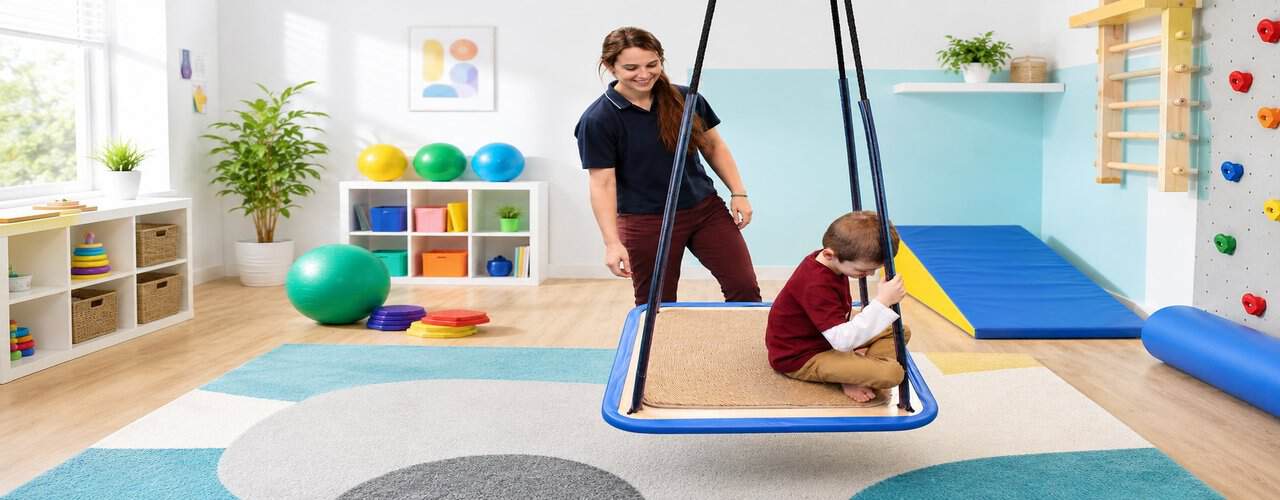
Sessions look like play because they are play. Swinging, climbing, jumping, brushing, deep pressure, balance challenges, fine motor games, sensory exploration. Each activity is chosen for the specific sensory input your child needs to organize. Over time, the nervous system reorganizes around better-regulated patterns, and your child can handle more of the everyday world without falling apart.
We also work closely with families. You are the most important part of your child’s therapy team. We teach you how to support your child’s sensory needs at home, at school, and in the community — because therapy doesn’t stop when the session ends.
What changes with sensory integration therapy
Children who receive sensory integration therapy at Synergy show improvements in self-regulation, attention, social participation, motor coordination, and daily living skills. Parents tell us their child seems calmer, more confident, more flexible with transitions, more able to handle the small frictions that used to derail the day. The world feels more manageable to the child — which means more manageable to the whole family.
That is what happens when a child’s nervous system gets the input it has been asking for.
Conditions and patterns we often see alongside sensory challenges
- Autism spectrum — sensory differences are common features
- ADD and ADHD — sensory regulation supports attention and focus
- Developmental delays — sensory foundations support motor, language, and social development
- Motor planning challenges — sensory input is essential for new motor learning
- Handwriting difficulties — touch, proprioception, and visual processing all contribute
A caregiver’s story
Not every story on this page comes from a parent. This one is from a professional caregiver who brought one of the residents at her center home to Synergy.
Hi, my name is Rhiannon Barry, and I work at a center home. I brought Nicholas with me.
Nicholas was having a lot of outbursts and a lot of things of that nature. When we first started coming here, we had to take a lot of breaks. We had to encourage him a lot to do things on his own — he would get very agitated and very irritated.
He has been coming for a little over a month, and just in that amount of time I have seen tremendous change. In his attitude and in how he does things. They work with him very well. They have great rapport with him here. He is more apt to do things on his own — and he is voicing things. He does what they ask him to do now, so much better. He laughs and giggles. He does a very good job.
The change was very quick — a few appointments even. I can tell the difference between the first appointment and this appointment, and we have only had six appointments. He is doing very good. Very quick.
They are very good with him. They do not push him too hard if he is not wanting to. But they push him the right amount. The change in him is so good, so tremendous. I cannot express it in words without you seeing it. The work they do is just mesmerizing — how all of it together has made him turn around and do so much.
— Rhiannon Barry, professional caregiver
What stands out in Rhiannon’s story is the pacing — the work happened quickly, but the therapists never pushed Nicholas past where his nervous system could go. That is exactly what good sensory integration work looks like: meeting the child where they are, then gently expanding what they can handle. The outbursts, the agitation, the difficulty doing things independently — none of those are character problems. They are signals from a nervous system that needs help organizing itself. When that help arrives in the right form, the change can be remarkably fast.
Recommended Reading
Deepen your understanding with these related articles from our health blog:
Frequently asked questions
What is a sensory diet and does my child need one?
A sensory diet is a personalized schedule of sensory activities designed to keep a child\’s nervous system regulated throughout the day. It might include movement breaks, deep-pressure activities, oral motor input, or specific calming strategies. Whether your child needs one and what it should look like comes out of the evaluation.
Can sensory processing disorder be outgrown?
Some children show meaningful reduction in sensory sensitivity as their nervous system matures, especially with targeted therapy. Others carry sensory differences into adulthood — and learn strategies to manage them effectively. “Outgrowing” is not the only path to function. Many adults with sensory differences live well with the right tools.
Is sensory processing disorder a recognized diagnosis?
It is recognized clinically by occupational therapists worldwide and by many physicians, and there is substantial research supporting it. It is not currently listed as a standalone diagnosis in the DSM, but the symptoms are recognized within autism, ADHD, and other neurodevelopmental categories — and they respond to targeted therapy regardless of whether the diagnostic label is formalized.
Why does my child cover their ears at normal sounds?
Over-responsivity to sound is one of the most common sensory patterns. The child\’s nervous system processes ordinary auditory input as overwhelming or even painful. With targeted sensory work, many children\’s auditory threshold gradually moves toward a more typical range.
How is sensory processing disorder different from autism?
They overlap significantly — most autistic children have sensory differences, and many children with sensory processing disorder do not have autism. Autism is a broader neurodevelopmental pattern that includes social communication, restricted interests, and repetitive behaviors alongside sensory differences. Sensory therapy is appropriate for both groups but targets different goals depending on the child.
This page was reviewed by Chandana Dash, OTR/L, who has practiced pediatric occupational therapy for more than 32 years and specializes in family-centered care for children with sensory, developmental, and neurodevelopmental challenges. She is the co-founder of Synergy Therapeutic Group in Carbondale, Illinois.
What are the early signs of sensory processing disorder?
Common early signs include: avoiding certain textures, foods, or clothing tags; covering ears at normal sounds; meltdowns in busy environments; clumsiness or seeking constant movement; difficulty with bath time, haircuts, or tooth brushing. One or two of these is normal childhood variation. A pattern that disrupts daily life — for your child or your family — is worth evaluating.
When should I worry about my child sensory behaviors?
Not when it is occasional — kids react big to new things and that is normal. Worry when it is consistent (happens most days), disruptive (interferes with school, sleep, family life), and not improving with age. If you find yourself rearranging your life around your child sensory reactions, that is the signal to ask an OT.
How long does sensory integration therapy take?
Most children show meaningful change within 3–6 months of weekly therapy. Lasting changes — where new patterns become automatic — often take 6–12 months. Sensory integration is not a quick fix; it is helping a developing nervous system learn new responses. We measure progress every few weeks so you can see what is shifting.
This page is for general education, not medical advice. Everyone’s body and history are different — for guidance on your specific situation, talk with a licensed physical or occupational therapist. Synergy Therapeutic Group · 1110 N Cedar Court, Carbondale, IL 62901 · (618) 243-7822.