

Serving southern Illinois families. Parents bring their children to our Carbondale clinic from Du Quoin, Marion, Herrin, Murphysboro, Carterville, and the wider region. See all the areas we serve.
Your child is not broken — they’re adapting. We work with the whole family to help your child grow, learn, and thrive — with or without a diagnosis.
You know something is off. You can’t always name it. Maybe their teacher mentioned it. Maybe a grandparent. Maybe it’s the feeling you’ve had since they were a baby that other parents don’t seem to share.
Meltdowns that don’t make sense. Picky eating that has gotten worse, not better. A child who can’t sit still — or won’t move at all. Trouble with handwriting. Refusing socks. Avoiding hugs. Toe-walking. Big reactions to small sounds.
You’ve asked the pediatrician. The pediatrician said wait. So you waited.
You’ve asked other parents. They shrugged and said “every kid is different.”
You’ve Googled at 11pm and ended up more confused than when you started. Maybe a doctor has named it — autism, ADHD, sensory processing, developmental delay — and the label gave you a word but not a plan. Or maybe nobody has named anything yet, and you’ve been told you’re worrying too much.
You’re not worrying too much. You are noticing something real. And your child is not broken — they’re adapting.
What is really happening
A child’s body and nervous system are constantly building. Building the ability to balance. To hold a pencil. To filter out background noise and focus on the teacher. To feel a tag on their shirt without it taking over their whole day.
When one of those building blocks isn’t fully in place, the rest of the system adapts around it. A child who can’t quite process touch might refuse certain clothes. A child whose vestibular system is underdeveloped might seek constant motion — or avoid it entirely. A child whose nervous system is overwhelmed might melt down at the end of every school day because they spent six hours holding themselves together.
This is not behavior. It is communication. It is your child’s body telling you what it needs.
It is also why a diagnosis doesn’t have to come first. Many of the children we work with have a diagnosis. Many do not. What matters is whether your child is struggling — and whether the family has the tools to help.
The family environment is the most powerful part of any child’s development. More powerful than any clinic. That is where we focus.
How Synergy approaches pediatric OT
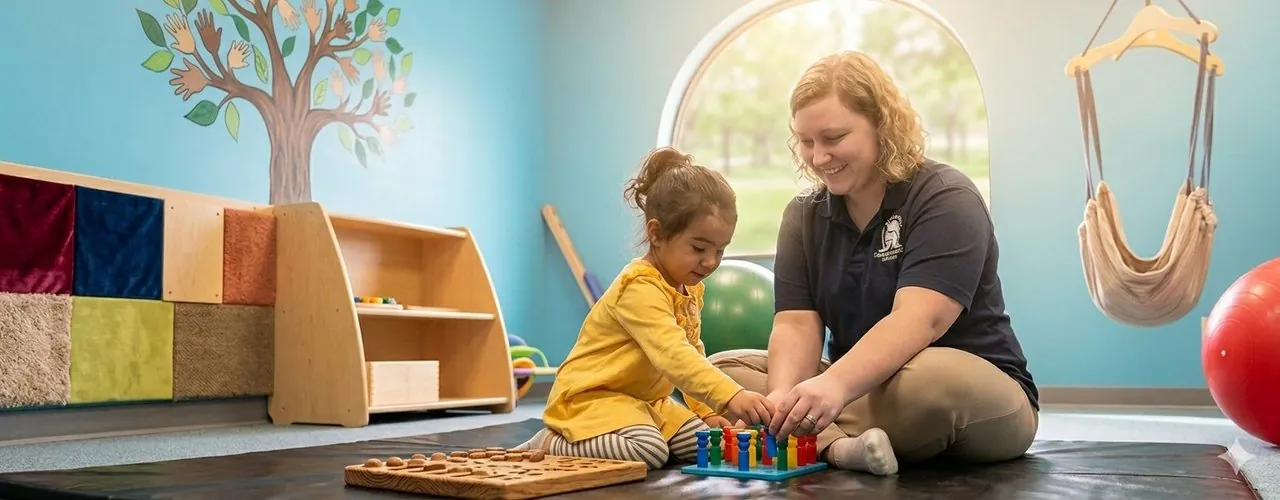
Pediatric occupational therapy at Synergy is family-centered. We don’t pull your child away for an hour and send them home unchanged. We work with your child and we work with you — because you are the one who is with them every day.
Your first visit is an evaluation. We look at how your child moves, plays, regulates, and connects. We listen to what you’ve been noticing — and we take it seriously.
Then we build a plan. Some of it happens in the clinic. A lot of it happens at home, with you. We give you specific things to do, real reasons why, and the confidence to keep going when progress is uneven.
We work with children of all ages — toddlers through teens. With or without a diagnosis. Locally in Carbondale, and nationally and internationally via telehealth.
Parent & Caregiver Training Program
Many of the families we work with want more than weekly visits. They want to deeply understand what is going on with their child, and they want practical tools they can use at home, every day.
That is what the Parent & Caregiver Training Program is for. It is built for parents who are ready to become the most powerful part of their child’s healing.
A parent’s story
She had been receiving some services from school, but she wasn’t really progressing in a lot of areas. She wasn’t following directions. Potty training was a huge thing with us — she just wouldn’t sit on the potty at all. My wife looked into it, ran across Synergy, and called to get some information. We wanted to get her all the help we could.
When she came in, her finger strength was very light. She wasn’t really using her muscles. She had horrible eye contact — rarely would you get her to look at you. She’d throw a lot of tantrums, drop to the floor. She wasn’t verbal. She would point and grab your arm to ask for what she wanted.
Since then, she’s much stronger. Her eye contact is really, really good. Potty training is going really well — sometimes she’ll sneak away from us, and we’ll find her sitting on the potty herself, flushing the toilet, washing her hands, just doing a wonderful job. She talks more. She hangs out with us instead of running off to do her own thing. The other day she said, “I want chocolate milk please.”
It definitely makes us feel a lot better. Hopeful. There were times we weren’t sure what her future was going to look like — she wasn’t verbal, she wouldn’t listen, she’d walk away. Now it looks to me like she’s going to be able to do just about anything she wants to do.
— Father of a Synergy pediatric patient
Recommended Reading
Deepen your understanding with these related articles from our health blog:
Frequently asked questions
What is the difference between occupational therapy and physical therapy for children?
Physical therapy focuses on gross motor skills, mobility, and physical recovery — walking, running, posture, strength. Occupational therapy focuses on the skills children need for their daily occupations — playing, learning, self-care, fine motor work, sensory regulation, and participating in school and family life. Many children benefit from both; the two are complementary.
At what age can my child start occupational therapy?
Infancy. Early-intervention OT can begin as soon as a developmental concern is identified — sometimes in the first months of life. We work with children of all ages from infants through teens, with the focus shifting based on what each developmental stage requires.
Can my child receive OT without a formal diagnosis?
Yes. Many of the children we work with do not have a diagnosis. If your child is struggling with sensory input, motor skills, self-regulation, or daily tasks, that is enough to warrant an evaluation. A formal diagnosis is sometimes useful for school accommodations or insurance, but it is not required to begin therapy.
How is private occupational therapy different from school OT?
School-based OT focuses specifically on the child\’s educational performance and is typically time-limited within the school day. Private clinic OT can go deeper on the underlying systems — sensory, motor, regulation — and address issues that affect home and community life beyond school. The two complement each other.
How will I know if therapy is working?
You will see changes in specific, observable ways: better tolerance of clothing or food textures, less explosive responses to transitions, more independence with self-care, smoother school mornings, improvements in handwriting or fine motor tasks, more verbal communication, more engaged play. We track specific goals at the evaluation and revisit them regularly.
How long will my child need occupational therapy?
It depends on what we are working on. Mild challenges often resolve in 3–6 months. Complex needs (significant developmental delays, sensory regulation, motor planning) may continue for 12+ months. We re-evaluate every 3 months and graduate your child as soon as the goals are met. Our goal is independence — not lifetime therapy.
What does the first OT evaluation look like?
A 60–90 minute session that feels more like guided play than testing. We watch your child move, problem-solve, and engage with sensory experiences while talking with you about milestones, behaviors, and what worries you. By the end, we have a clear picture of strengths and challenges plus a plan you can act on right away.
Does insurance cover pediatric occupational therapy?
Most major insurance plans cover medically necessary pediatric OT. Coverage varies — some plans require a doctor referral, some cap visits per year, some have deductibles. We verify your specific benefits before your first session so there are no surprises. We also offer transparent self-pay rates for families who prefer to skip insurance.
What should my child wear to OT sessions?
Comfortable, easy-to-move-in clothes — leggings, sweatpants, t-shirts. Socks (no shoes inside the gym). Avoid jeans, restrictive clothing, or anything your child finds uncomfortable. Many of our sessions involve climbing, swinging, and floor work, so being able to move freely matters.